It is no doubt pointless to try to give a definition of the ʻworldʼ other than one that is tautological in form, like the one Heidegger attempted with the celebrated formula, Die Welt weltet, ʻthe world worldsʼ, the world is nothing other than its own becoming-world.
However, as soon as there is a question of interpreting it, this enunciation loses its evident simplicity. Die Welt weltet can be understood in at least two senses which are antagonistic if not contradictory. This formula can be understood first as the expression that sums up and completes the whole history of philosophy. Hegel has powerfully shown this: there is no history except the history of the world, Weltgeschichte, universal history. And no world that is not on the way towards its own world-making – that is, towards the realization of the Idea, or the accomplishment of spirit. ʻThe world worldsʼ, from a Hegelian point of view, thus means that the world is nothing other than the sense of the world, with history appearing precisely as the movement of reconciliation between the world and its sense.
But die Welt weltet also expresses a mode of being of the world, the very being of the world precisely in so far as it ceases to be interpreted in terms of what the metaphysical tradition calls sense and history. It is just this being of the world that Heidegger is aiming at with his formula. For Heidegger, as we know, the sense of being – that is, the destiny (Geschick) – of the epochs of being is not strictly speaking historical. By the same token, sense is no longer ordered according to a teleology. The world is what it is; it is its own coming to being (west), in some sense; and what has been called history rests, perhaps, on nothing but the concealment of the constitution of the being of the world – the constitution of being that one can only let be, which is what is meant by Gelassenheit, or ʻserenityʼ.
I do not intend here to develop the Heideggerian idea of the world, but simply to insist on the fact that die Welt weltet can be read at the same time according to a historical sense and a ʻpost-historicalʼ sense – historial in French. It is in-between what for a long time was called ʻhistoryʼ and what can no longer carry this name that I would like to try to situate my discourse. One of the phenomena that most obviously lets us see and think this in-between is without doubt the phenomenon that we call today globalization, mondialisation in French, or Globalisierung in German. The very word ʻglobalizationʼ can be used in a translation of the Heideggerian formula which has sometimes been proposed: ʻthe world globalizes itselfʼ (le monde se mondialise). And in fact, ʻglobalizationʼ even seems to articulate the two significations of the becoming-world of the world implied by die Welt weltet: the historical signification and the post-historical signification.
On the one hand, indeed, globalization clearly incarnates the accomplishment of history conceived as Weltgeschichte. Recall that the works of Fukuyama insist on the equation of globalization with the Hegelian conception of absolute knowing. And one can see at the heart of the process of globalization, as in the Hegelian reading of history, a certain number of ethnocentric principles at work which tend to confirm and extend the supremacy of the West. The immediate effects of globalization are well known: the pace and extent of transportation and telecommunication; the movement of persons, commodities, modes of production; and socio-political models based on a market constantly kept open. Globalization is in itself a contradictory process which tends towards homogenization while at the same time revealing and dissimulating economic, cultural and linguistic hegemonies. Above all, the discontents aroused by this process, which, by means of the technological revolution that History and the process of mourning in Hegel and Freud
Catherine malabou
accompanies it, only widens the gap between rich and poor and between North and South, testify to this.
But at the same time, globalization is a phenomenon that cannot be reduced to this logic of domination. This is because its movement implicates another regime of events, another becoming, another future, another functioning of the world besides the ones presupposed by the traditional concept of history. It is clear that under the name of globalization a new internationality is being sought, an internationality that is no longer Weltgeschichte, which precisely breaks with historicist universalism. The signs of this emergence are given in particular in international law, with the endlessly renewed and enriched affirmation of the Rights of Man, and with the setting in place of international penal authorities (especially since the appearance in 1945 of the concept of a crime against humanity, which includes war crimes and, more often, the crime of genocide). These authorities allow for the putting into question of the teleological principle that animates the sovereignty of nation-states. Globalization, understood according to this supra-nationality, might perhaps prepare, after history, for something like a political Gelassenheit, conceived as a non-dominatory opening to the other.
In this in-between of the world which constitutes globalization, there is at once a solidarity and a farewell to itself of the world – as if the world affirmed its future while carrying out its own mourning. And indeed, as the title indicates, it is just on mourning that I plan to insist here, in showing that there is no ʻworld-makingʼ, and further no world, no history, no historicality, without mourning, and that the passage from one signification of globalization to another implies the passage from one signification of mourning to another. I will show first, starting with Hegel but also using Freud, that history in its traditional sense and the process of mourning called ʻsuccessful mourningʼ are inseparable, and determine a certain vision of the world whose trace the phenomenon of globalization still carries. I will then show that a true supranationality – that is, a non-hegemonic internationality – requires another concept of mourning, delivered from the obsession of success or normality.
Getting it right
Let us open the Lectures on the Philosophy of History to see how Hegel describes the funerary practices of the Chinese.
When the father dies, the son must stay in mourning for three years, abstaining from meat and wine.… No marriage must occur during the family mourning. Only the age of fifty delivers one from the excessive severity of mourning, in order that the bereaved not become emaciated; the age of sixty softens it still further, and the age of seventy reduces it entirely to the colour of oneʼs clothing.… It is an indispensable requirement that the tomb of the parents be visited every year.… The corpse of the deceased father is often kept three or four months at the family house, and during this time no one must sit in a chair or sleep in a bed.
Let us leave China to touch on the funerary practices of the Hindus. Indians, contrary to the Chinese, do not preserve; they burn. The religion of Brahma ʻholds a negative position towards all that is concreteʼ. For this reason, there is ʻlittle costʼ to the people in ʻsacrificing themselves to annihilation, and the custom which wants women to be burned after the death of their husbands is connected with this conceptionʼ. Equally ʻconnected with this conceptionʼ is the fact that the bodies of the deceased are necessarily cremated. The characteristic of India, for Hegel, is ʻevanescenceʼ.
Two peoples, two cultures. Two types of mortuary rites. Their description is far from being anecdotal. The Lectures on the Philosophy of History grant legitimacy to these rites in all the cultures that they study: Hindu, Egyptian, Greek and Christian, to name only these four. For Hegel, universal history roots itself entirely in the relation that civilizations and peoples maintain towards death, in so far as history in itself is mourning. And according to Hegel, it is the manner in which each culture performs the work of mourning that permits one to apprehend the structure of its historical consciousness.
It is thus possible to affirm that history and the process of mourning are co-originary and determine one another. Chinese and Hindu funerary practices allow us to throw light on two extremes. One could characterize these on the one side as an excess of preservation – Chinese mourning is interminable – and, on the other side as an excess of suppression – Hindu mourning is too short, too radical; consumption by fire does not permit the true conservation of the spirit of the departed. Mourning is only truly possible when the right proportion of suppression and preservation is found. Yet the search for this right proportion is inseparable from the very movement of history. From the Orient to the Occident, in the course of the long working day of spirit, history searches for itself and finds itself as a right proportion between maintenance and annihilation: in a word, as Aufhebung. One will have recognized, in the equilibrium between these two constitutive principles of the work of mourning, the very motor of the dialectic.
History is only possible when it guarantees for itself the tuning of a mechanism, namely that of memory, which necessarily requires that the relation to the past is constituted as both a conservation and a loss: in the in-between of obsessive recollection and total forgetting – in the in-between of two abstract negations, as Hegel would say.
Freud later posits the same necessity. Mourning can escape melancholic depression only if the memory, also called the ʻmnemic traceʼ, of the departed, does not give rise to the repetition of an old affect, and disallows any ʻclinging to the object through the medium of a hallucinatory wishful psychosisʼ. Mourning requires detachment; it presupposes a capacity of suppression and forgetting: the libido, says Freud, must detach itself from the ties that bind it to the object. But mourning also, of course, requires a kind of preservation: ʻthe existence of the lost object is pursued psychicallyʼ. Here again, it is between the excess of preservation and the excess of suppression that the work of mourning is located. In fact, the two excesses come back to the same, are basically the same thing. The dead person who dies endlessly – in the melancholic obsession – never dies and is thus, by that very token, negated since his or her disappearance is thereby perpetuated. Interminable suppression merges with infinite preservation; this confusion in a real sense prohibits all history.
Hegel shows this. From one culture to another, the right proportion is sought. Here or there, too much or not enough preservation. Pyramids, mummies, funeral pyres, temples, crypts – too much or too little; mourning feels its way towards self-discovery in order to accomplish itself finally in the West, at the very tip of the West, where history at once begins and completes itself.
Completed, accomplished history presupposes the non-pathological possibility of a return. How can the departed come back without invading the mind – that is, without turning it away from present effectivity? This requirement of a non-obsessional reiteration passes through two distinct types of vestige: the monument, which allows for commemoration and hence for return, but a return freed from the crushing weight of determinate being, as Hegel would say; and the wound, which arouses the incessant recommencement of the old emotion.
This difference between two types of trace corresponds to the distinction that Freud makes in Five Lectures on Psychoanalysis between ʻcommemorative symbolsʼ and ʻhysterical symbolsʼ:
The monuments with which we adorn our big cities are commemorative symbols of the same type. So in London, you will find, in front of one of the largest train stations in the city, a richly decorated gothic column: Charing Cross. In the 13th century, one of the old Plantagenet kings who was transporting the body of Queen Eleanor raised gothic crosses at each station where the coffin was placed on the ground.
Charing Cross is the last of the monuments that was to preserve the memory of this funeral march.
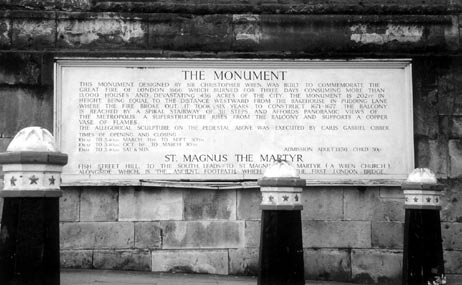
At another place in the city, not far from London Bridge, you will notice a very high modern column that they call The Monument. It was designed to recall the memory of the great fire which, in 1666, burst out nearby and destroyed a great part of the city. These monuments are commemorative symbols, and a comparison with hysterical symbols is tenable up to this point. But what would you say about an inhabitant of London who, even today, would halt melancholically in front of the funeral monument of Queen Eleanor instead of taking care of business with the haste that modern conditions of work require, or of delighting in the young and charming queen who captivates his own heart today? Or what would you think of someone who shed tears in front of the monument for the destruction of the city of his fathers, even though this city was reborn from its ashes a long time ago and radiates with a burst that is more lively than ever before?
Hysterics and other neurotics behave like the two Londoners in our improbable example. Not only do they recollect the sad events that occurred long ago, but they are still actually attached to them; they do not free themselves of the past, and for its sake neglect the reality of the present. These hysterics and neurotics already have names in Hegel, who throughout his work charts the figures that do not overcome, in the strong dialectical sense of the term, the passing away, and hence who make a big deal out of history and at the same time turn history into emptiness. History for the record but no monument.
These forms of failed mourning, which result from the fact that consciousness is in a perpetual oscillation between preservation and sacrifice, in a perpetual diremption of the Aufhebung, are thus incarnated for Hegel by the various civilizations which have not yet arrived, and in a sense will never arrive, at the accomplishment of their concept – that is to say, will never make their world world.
Being plastic
How do oscillation and hesitation, the characteristics of failed mourning, resolve themselves? They are resolved thanks to what Hegel names the process of ʻidealizationʼ (das Idealisieren). To idealize is indeed to suppress and preserve at the same time – in a word, to do oneʼs mourning. Idealization is the result of Aufhebung, which presupposes that one is capable of keeping within oneself the very thing of which one endures the loss. Hegel has another word for designating idealization, namely ʻassimilationʼ (Assimilation): ʻIn every natural and spiritual life-process, the essential thing is assimilationʼ, he says in section 345 of the Encyclopedia. To idealize is to assimilate, to make oneʼs own, to appropriate an object for oneself, which always presupposes that one separates oneself from it or else destroys it. Idealization thus appears as the very possibility of commemoration liberated from every kind of hysterical return.
As I indicated above, Aufhebung incarnates the very form of what Freud calls successful mourning. And if for Hegel it is in the West that this form is found and completes itself, it is because two exemplary mournings come to be inscribed as the very paradigms of thought: the death of Socrates, ʻthe foundation, as such, of philosophyʼ, and the death of Christ, the foundation of the properly historical conception of the work of spirit. Every Western subject symbolically bears these two mournings at the same time, which reveals precisely the right proportion between suppression and preservation, and gives to historical consciousness the good logos, or the good ratio of suppression and preservation.In another work, adopting for my own purposes a Hegelian concept, I have used the term ʻplasticʼ to name this successful mourning, which thus finds the right proportion between fixity and evanescence, obsession and absolute forgetting. The relation that the world maintains with its history would have to be plastic. And perhaps a similar conception of mourning is also affirmed by Nietzscheʼs claims in the Second Untimely Meditation:
There is a degree of sleeplessness, of rumination, of the historical sense, which is harmful and ultimately fatal to the living thing, whether this living thing be a man or a people or a culture. To determine the degree, and therewith the boundary at which the past has to be forgotten if it is not to become the gravedigger of the present, one would have to know exactly how great the plastic power of a man, a people, a culture is: I mean by plastic power the capacity to develop out of oneself in oneʼs own way, to transform and incorporate into oneself what is past and foreign, to heal wounds, to replace what has been lost, to recreate broken moulds.
The ʻplastic powerʼ appears here, too, as the power of healing over a wound, which cures resentment and thus also melancholy.
One can only be struck, in reading Hegel, by the normative character – one might say the Graecoor Christian-centred character – of the conception of mourning which in his work accompanies the march of history. Everything takes place as if spirit, as Hegel conceives it, was not thinkable outside a certain normality of mourning, a certain lesson of memory imposed on other peoples and other cultures. In fact, are we not still today always ready to judge the resistances opposed to globalization – fundamentalisms, calls for identity politics, border closings, reactions against technology – are we not thus always ready still to judge them as non-plastic pathological forms of melancholy, of hysteria, of an incapacity to abandon phantoms and to settle up with the past in order to engage effectively in the world? Are we not still too quick to decide that such and such a culture, such and such a political regime or social model, is still posed at the threshold of history? That it is living today at the end of history without ever having known or experienced its beginning?
The work of mourning that since Freud is called ʻsuccessfulʼ or ʻnormalʼ is likewise for its part conceived as a movement of idealizing interiorization which takes into itself the alterity of the departed, appropriates it for itself and thus negates precisely its alterity. ʻNormal mourningʼ is this process which makes of the other a part of the ego, and tends to trivialize this assimilation. Jessica Mitford, in The American Way of Death, has described well this banality of mourning in the West, its efforts to shorten the time of mourning, to efface its signs, to condemn and conceal any melancholic overflow. It is certain that in many respects globalization imposes this banality on the entire planet, often asking peoples to renounce some of their most prominent cultural practices. This process of global trivialization marks the achievement, in the double sense of this term, of history.
The question is to know whether and how it is possible to renounce this normative model, which comes down to asking whether or not it is really possible to perform a successful mourning. In his book Memoires For Paul de Man, Jacques Derrida opposes to what is called the ʻnormalʼ work of mourning that which he calls impossible mourning, which no longer rests on an idealization conceived as Aufhebung. Impossible mourning is one which, ʻleaving the other his alterity, respecting thus his infinite remove, either refuses to take or is incapable of taking the other within oneself, as in the tomb or the vault of some narcissismʼ.
Impossible mourning presents another alternative to the Freudian one between elimination and melancholy, to the extent that it renounces at the same time the appropriation of the idea of the other as well as pure and simple grief and lamentation. This mourning, in the manner of a merely apparent paradox, is an affirmation. Derrida: ʻthis single affirmative affirmation must affirm the impossible.… The impossible here is the other, such as he comes to us: as a mortal, to us mortals.ʼ
Understood now as this affirmation of the impossible, the globalization of the world appears as this welcoming of the other which does not put him to death, which does not embalm him in advance before even having met him. Only this welcome, the condition of a non-prescriptive memory which does not prejudge the destiny of the originary trace of the other in us, can guide the march of the new internationality and of supranational political and legal institutions delivered from the obsession of normal mourning and its banality. This deliverance could thus appear as Gelassenheit, the serenity of a world which bears its own mourning, the mourning for its own historical character – that is, the mourning of mourning – without ever counting it as successful, and without remaining nostalgic for it either.
To conclude, we must pose the question, how is such an ʻaffirmation of the impossibleʼ possible? Impossible mourning, I have said, is the non-interiorizing welcoming of the alterity of the other, which presupposes another plasticity, as a non-integrative suppleness. Yet, and we thus return to the problem of history, is it not necessary, in order for this impossible mourning to take place, that the world hold in itself the secret of another possible, another concept of the possible than the historical possible, a non-realized possibility, non-realizable, non-actualizable in an event? Is it not necessary that the world hold in itself the secret of an impossible possible, namely a possible that remains forever possible without incarnating itself in an actuality? That possible would be precisely the name of the other, of the entirely other, other than anything that takes place, other than anything that has already been produced in history, the other of history, without reference to a foundational event. Everything surely could have taken place otherwise, could have been other, could have had a completely other chance. This vertigo of the completely other origin is neither a shadow nor a phantom; it is neither appropriable nor idealizable by the psyche. Yet, it doubles up the present with a mourning, the mourning precisely of the possible, of everything that the present excludes as unaccomplished, and which remains virtually, Bergson would say, as the trace of the other. This trace is, to use once again a Freudian concept introduced in Inhibitions, Symptoms and Anxiety, and which again one should extract from its pathological connotation – this trace, then, is that of the ʻnon-eventʼ (non advenu) or of the ʻnot having happenedʼ (non arrivé). The world thus bears the mourning of that which has not arrived, the worse trace or what is unaccomplished in the actual event. But as the non-event has precisely never taken place, and is by definition not historical, its mourning cannot exist in the order of idealization. The mourning of the possible, in the double sense of the genitive, can only be the conservation of the possible itself which does not reify it in an image or a phantasm. Thus conserved, the possible remains forever possible, and to this extent the not having happened is also the resource for that which can arrive, the resource of all faith in the future, of all confidence in another becoming of the world. Die Welt weltet, the world worlds, the world globalizes itself. Moving from one understanding of this formula to the other, it is a sense of the possible that is at stake, a possible that does not allow itself to be fixed either in a monument or in a wound. This possible allows us to think the conditions of an identity which would not be that of an egoism destructive of the self and of the other, the conditions of an identity that differs from itself and would be affected neither by a tendency towards its own auto-celebration (the form of the monument) nor by a narcissistic suffering (the form of the wound). The plasticity of this new identity would permit it, as Nietzsche says in his later thought, ʻto regenerate itself, to heal, and even to forgetʼ – that is to say, perhaps, no longer even to need to bear the work of mourning.
Translated by jay lampert
Andolivier serafinowicznotes
Payot, Paris, p. 15; Standard Edition, vol. XI, pp. 16–17.
Vrin, Paris, 1967, p. 201; Philosophy of Nature, trans.
M.J. Petry, Humanities Press, New York, 1970, vol. III, p. 54.
Presses Universitaires de France, Paris, 1993, pp. 34–5. Inhibitions, Symptoms and Anxiety, Standard Edition, vol. XX, p. 120. The English translation footnotes the fact that Freud uses the French term ʻnon arrivéʼ and in the body of the text translates the term as ʻnot having happenedʼ [trans.].


