https://www1.folha.uol.com.br/mercado/2021/03/privatizar-para-quem.shtml?
segunda-feira, 1 de março de 2021

Roberto Romano - sobre o antirepublicanismo na tradição religiosa no Brasil
https://www.caiosouto.com/63-por-uma-nova-macrofisica-do-poder-entrevista-com-roberto-romano/?fbclid=IwAR0CBt5WnsCCj3Sjo1xlJ4SiSjQuKT9VPgrmhFeUXXYcN99E0vumJc1oC3o
sábado, 27 de fevereiro de 2021
The abuses of Popper
sophically minded researchers – iIf you ask philosophically minded researchers n the Anglophone world at least – why it is that science works, they will almost always point to the philosopher Karl Popper (1902-94) for vindication. Science, they explain, doesn’t presume to provide the final answer to any question, but contents itself with trying to disprove things. Science, so the Popperians claim, is an implacable machine for destroying falsehoods.
Popper spent his youth in Vienna, among
the liberal intelligentsia. His father was a lawyer and bibliophile, and an
intimate of Sigmund Freud’s sister Rosa Graf. Popper’s early vocations draw him
to music, cabinet making and educational philosophy, but he earned his
doctorate in psychology from the University of Vienna in 1928. Realising that
an academic post abroad offered escape from an increasingly antisemitic Austria
(Popper’s grandparents were all Jewish, though he himself had been baptised
into Lutheranism), he scrambled to write his first book. This was published
as Logik der Forschung (1935), or The Logic of
Scientific Discovery, and in it he put forward his method of falsification.
The process of science, wrote Popper, was to conjecture a hypothesis and then
attempt to falsify it. You must set up an experiment to try to prove your
hypothesis wrong. If it is disproved, you must renounce it. Herein,
said Popper, lies the great distinction between science and pseudoscience: the
latter will try to protect itself from disproof by massaging its theory. But in
science it is all or nothing, do or die.
Karl Popper, 1987. Photo by Süddeutsche
Zeitung/Alamy
Popper warned scientists that, while
experimental testing might get you nearer and nearer to the truth of your
hypothesis via corroboration, you cannot and must not ever proclaim yourself
correct. The logic of induction means that you’ll never collect the infinite
mass of evidence necessary to be certain in all possible cases, so it’s better
to consider the body of scientific knowledge not so much true as
not-yet-disproved, or provisionally true. With his book in hand, Popper
obtained a university position in New Zealand. From afar, he watched the fall
of Austria to Nazism, and commenced work on a more political book, The
Open Society and its Enemies (1945). Shortly after the war, he moved
to the UK, where he remained for the rest of his life.
For all its appealing simplicity,
falsification was quickly demolished by philosophers, who showed that it was an
untenable way of looking at science. In any real experimental set-up, they
pointed out, it’s impossible to isolate a single hypothetical element for
disproof. Yet for decades, Popperianism has nonetheless remained popular among
scientists themselves, in spite of its potentially harmful side-effects. Why
should this be?
It was a group of biologists that gave Popper his
first scientific hearing. They met as the Theoretical Biology Club in the 1930s
and ’40s, at the University of Oxford, at house parties in Surrey, and latterly
in London too. Popper visited them both before and after the war, as they
wrestled with evolutionary theory and with establishing connections between
their different biological specialisms. During the prewar period in particular,
evolutionary biology was – depending on one’s outlook – either excitingly
complex or confusingly jumbled. Neat theories of Mendelian evolution, where
discrete characteristics were inherited on the toss of a chromosomal coin,
competed to explain evolution with arcane statistical descriptions of genetic
qualities, continuously graded across populations. Meanwhile the club’s leading
light, Joseph Henry Woodger, hoped for a philosophically tight way of
clarifying the notoriously flaky biological concept of ‘organicism’. Perhaps
Popper’s clarifying rigour could help to sort it all out.
Photo
supplied by the author
It is a striking fact that Popper’s most
vocal fans came from the biological and field sciences: John Eccles, the
Australian neurophysiologist; Clarence Palmer, the New Zealand meteorologist;
Geoffrey Leeper, an Australian soil scientist. Even Hermann Bondi, an
Austrian-British physical scientist, who operated at the speculative end of
cosmology. In other words, it was the scientists whose work could least easily
be potted in an attempted laboratory disproof – Popper’s method – who turned to
Popper for vindication. This is odd. Presumably, they hoped for some
epistemological heft for their work. To take a wider angle on the mystery, we
might note the ‘physics envy’ sometimes attributed to 20th-century field scientists:
the comparative lack of respect they experienced in both scientific and public
circles. Popper seemed to offer salvation to this particular ill.
We don’t conclude we’ve disproved
well-established laws of physics – rather, that our experiment was faulty
Among the eager philosophical
scientists of the Theoretical Biology Club was a young man named Peter Medawar.
Shortly after the Second World War, Medawar was drafted into a lab researching
tissue transplantation, where he began a Nobel-winning career in the biological
sciences. In his several books for popular audiences, and in his BBC Reith
lectures of 1959, he consistently credited Popper for the success of science,
becoming the most prominent Popperian of all. (In turn, Richard Dawkins
credited Medawar as ‘chief spokesman for “The Scientist” in the modern world’,
and has spoken positively of falsifiability.) In Medawar’s radio lectures,
Popper’s trademark ‘commonsense’ philosophy was very much on display, and he
explained with great clarity how even hypotheses about the genetic future of
mankind could be tested experimentally along Popperian lines. In 1976, Medawar
secured Popper his most prestigious recognition yet: a fellowship, rare among
non-scientists, at the scientific Royal Society of London.
While all this was going on, three
philosophers were pulling the rug away beneath the Popperians’
feet. They argued that, when an experiment fails to prove a
hypothesis, any element of the physical or theoretical set-up could be to
blame. Nor can any single disproof ever count against a theory, since we can
always put in a good-faith auxiliary hypothesis to protect it: perhaps the lab
mice weren’t sufficiently inbred to produce genetic consistency; perhaps the
chemical reaction occurs only in the presence of a particular catalyst.
Moreover, we have to protect some theories for the sake of
getting on at all. Generally, we don’t conclude that we have disproved
well-established laws of physics – rather, that our experiment was faulty. And
yet the Popperians were undaunted. What did they see in him?
The historian Neil Calver argued in 2013 that members of the Royal
Society were swayed less by Popper’s epistemological rules for research than by
his philosophical chic. During the 1960s, they had been pummelled by the ‘two
cultures’ debate that cast them as jumped-up technicians in comparison with the
esteemed makers of high culture. Philosophy was a good cultural weapon with
which to respond, since it demonstrated affinity with the arts. In particular,
Popper’s account of what came before falsification in research
was a good defence of the ‘cultural’ qualities of science. He described this
stage as ‘conjecture’, an act of imagination. Medawar and others made great
play of this scientific creativity in order to sustain cultural kudos for their
field. Their Popper was not the Popper of falsification at all, but another
Popper of wishful interpretation.
Although important to its participants,
the two cultures debate was a storm in an institutional
teacup. During the 1950s and ’60s, when Popper’s Logik der Forschung was
available in English (The Logic of Scientific Discovery, 1959), clouds
were gathering that threatened to flood out more than the chinaware of the
Royal Society. In the public mind, the scientist was becoming a dangerous
figure, the bogeyman responsible for the atomic bomb. Stanley Kubrick’s Dr
Strangelove (1964), played in so memorably deranged a fashion by Peter
Sellers, was the embodiment of the type. Strangelove struck at the heart of
Popperian ideals, an unreconstructed Nazi operating at the military-industrial
nerve-centre of the ‘free world’. As such, he reflected the real-life stories
of Nazi war criminals imported by Operation Paperclip to the US to assist in
the Cold War effort – a whitewashing project uncovered as early as 1951
by The Boston Globe. Against such a backdrop, the
epistemic modesty of Popperian science was appealing indeed. Real scientists,
in the Popperian mode, abjured all politics, all truths. They didn’t attempt to
know the atom, still less to win wars. They merely attempted to disprove
things. As Medawar put it in The Hope of Progress (1972):
The Wicked Scientist
is not to be taken seriously … There are, however, plenty of wicked
philosophers, wicked priests and wicked politicians.
Falsification was a recipe to proclaim
personal modesty as well. In an interview in 2017 for the Oral History of
British Science project, the crystallographer John Helliwell rejected, with
some embarrassment, the notion that he might have been responsible for any
revolutionary ‘paradigm shift’ in science (the coinage of Popper’s
contemporary, Thomas Kuhn), when he pioneered a new method for visualising
proteins and viruses, reaching instead for the humble method of falsification
to describe his work.
It was, and remains, intellectually
shortsighted to disconnect science and ethics in this way
One person’s modesty, however, can be
another person’s denial of responsibility. A darker way of rendering the Popper
vs Strangelove story is to say that falsification offers moral
non-accountability to its adherents. A scientist can never be accused of supporting
the wrong cause if their work is not about confirmation. Popper himself declared that science is an essentially
theoretical business. Yet it was a naïve scientist working during the Cold War
who didn’t realise the significance of their funding source and the
implications of their research. Medawar, for example, knew full well that his
own field of immunology sprang directly from attempts at skin grafting and transplantation
on wounded victims of the Second World War. Moreover, he was perfectly aware of
the high body-count involved in its experiments (including the use of
guillotined criminals in France) – by no means unethical in all cases,
but certainly far from theoretical.
Microscopic
slides showing the development of grafted tissue, from an early paper by Peter
Medawar. Courtesy the Wellcome Library
The Popperian get-out clause was
deployed in that most controversial of 20th-century sciences, eugenics. Medawar
didn’t hesitate to deploy the supposed moral non-accountability of science in
defending eugenics, the topic that furnished the basis of his BBC lectures and
much that followed. His argument was a subtle one, separating the science of
eugenics into two types. ‘Positive’ eugenics – the creation of a perfect race –
he characterised as bad because it was (a) Nazi, and (b) an unfalsifiable
scientific goal – un-Popperian on two counts. This left the field clear for
Medawar to lend his support to ‘negative’ eugenics, the deliberate prevention
of conception by carriers of certain genetic conditions. This, claimed Medawar,
was a strictly scientific (that is, Popperian) question, and didn’t touch upon
matters of ethics. It was something of an invidious argument.
With Popperian impatience over
so-called mere semantics, Medawar brushed away worries that the eugenic word
‘fitness’ implied a judgment about who was ‘fit’ or not to be a part of
society. Rather, Medawar claimed, it was a mere tag of convenience for an idea
that had perfect clarity among evolutionary biologists. Ordinary people
shouldn’t worry themselves about its implications; the important thing was that
scientists had it straight in their minds. Science merely provided the facts;
it was for the potential parent to decide. On one level, this sounds innocuous
– and Medawar was by no means a bad person. But it was, and remains,
intellectually shortsighted to disconnect science and ethics in this way. To
suppose a situation in which a potential parent will exercise a perfect and
unencumbered liberal choice lends unwarranted impartiality to the scientific
facts. In reality, economics or politics might force that parent’s hand. A more
extreme example makes the case clear: if a scientist explains nuclear
technology to a bellicose despot, but leaves the ethical choice of deployment
to the despot, we wouldn’t say that the scientist had acted responsibly.
As he prepared his lectures on the ‘future of man’, Medawar
speculated that biological ‘fitness’ was in fact best understood as an economic
phenomenon:
[I]t is, in effect, a
system of pricing the endowment of organisms in the currency
of offspring: ie, in terms of net reproductive performance.
Making such a connection – between the
hidden hand of nature and the apparently impartial decisions of the market –
was a hot way to read Popper. His greatest fans outside the scientific
community were, in fact, economists. At the London School of Economics, Popper
was close to the neoliberal theorist Friedrich Hayek. He also taught the
soon-to-be billionaire George Soros, who named his Open Society Foundations
(formerly, the Open Society Institute) after Popper’s most famous book. Along
with Hayek and several others, Popper founded the Mont Pelerin Society,
promoting marketisation and privatisation around the world.
Popper’s appointment to a fellowship at the Royal
Society marked the demise of a powerful strand of socialist leadership in
British science that had begun in the 1930s with the cadre of talented and
public-facing researchers (J D Bernal, J B S Haldane and others)
whom the historian Gary Werskey in 1978 dubbed ‘the visible college’. Indeed,
Popper had encountered many of them during his prewar visits to the Theoretical
Biology Club. While they were sharpening their complex science against the edge
of Popper’s philosophy, he might well have been whetting his anti-Marxist
inclinations against their socialised vision of science – even, perhaps, their
personalities. What Popper did in The Open Society was take
the biologists’ politicising of science and attach it to antifascism. Science
and politics were connected, but not in the way that the socialists claimed.
Rather, science was a special example of the general liberal virtues that can
be cultivated only in the absence of tyranny.
After the war, the commitment of
visible-college scientists to nation-building saw them involved in many areas
of governmental, educational and public life. The Popperians hated them.
In The Road to Serfdom (1944), Hayek warned that they were
‘totalitarians in our midst’, plotting to create a Marxist regime. They should
leave well alone, he argued, and accept that their lab work bore no connection
to social questions. Hayek’s bracketing off of governance was no more plausible
in science than it was in economics. The greatest myth of neoliberalism is that
it represents a neutral political perspective – a commitment to non-meddling –
when in fact it must be sustained through aggressive pro-business propaganda
and the suppression of organised labour. So, while Soros’s social activism has
done much good in the world, it has been funded through economic activity that
depends upon a systematic repression of debate and of human beings for its
success. Having a philosophical cover-story for this kind of neoliberalism,
that likens it to (Popperian) science, does it no harm at all.
In thinking and writing about Popper,
one becomes very conscious of antisemitism. Popper fled Nazi hatred in 1930s
Austria; today, Soros is the victim of antisemitic slurs that would be
ridiculous were it not for the history and the real threat of continued
violence in which they are rooted. We do well to remember the biographical
reasons that Popper had for advancing an open society, and for trying to redeem
science from the sins committed by Nazi researchers. The sly elision of fascist
and socialist science as the opponent to Popperianism – sometimes deliberate,
sometimes unconscious – is a move for which it’s more difficult to find
sympathy.
It doesn’t take much time online to
find examples of Popperianism wielded by climate change deniers
Science is profoundly altered when
considered analogous to the open market. The notion that scientific theories
vie with one another in open competition overlooks the fact that research
ambitions and funding choices are shaped by both big-p and small-p politics.
There is a reason why more scientific progress has been made in drugs for the
treatment of diseases of wealth than of poverty. Moreover, career success in
science – which shapes future research agendas when a person becomes a leader
in their field – is a matter profoundly inflected by gender, race, class and
dis/ability.
Scientists
refused Popper’s distinction between science and ethics in Science for
the People (this issue from 1974). Courtesy the Wellcome
Library
Some unscrupulous researchers even used
a Popperian frame to become, precisely, the ‘wicked scientists’ whose existence
Medawar denied. As the historians Naomi Oreskes and Erik Conway describe in Merchants of Doubt (2010),
scientists in the US and the UK were co-opted as lobbyists for tobacco
companies during the late-20th century to cast doubt upon research that
revealed a link between smoking and cancer. No such link could be proved, in
Popperian terms; and that room for doubt was ruthlessly exploited by the
scientists’ paymasters. Many of the same scientists went on to work for fossil
fuel lobbyists, casting doubt on the science of anthropogenic climate change.
It doesn’t take much time on a search engine to find examples of Popperianism
wielded by deniers. In a YouTube video from 2019, the Clear Energy Alliance
(which DeSmog Blog lists as funded by oil interests) called upon the ‘legendary
scientific philosopher Karl Popper’. The group’s central claim is that: ‘In
order to know if a theory could be true, there must be a way to prove it to be
false. Unfortunately, many climate change scientists, the media and activists
are ignoring this cornerstone of science.’ At the same time, academics at
recognised universities write scholarly sounding papers for the libertarian,
neoliberal and sceptic Cato Institute arguing that ‘Popper’s evolutionary
epistemology captures … the essence of science, but the conduct of climate
science today is a far cry from [it]’. Such writers typically hail from the
fields of economics and policy rather than science; untroubled by the critique
of scientists, Popper’s contested and outdated account of science suits them
perfectly.
While Hayek et al held the smoking gun
of Popperian mischief, there were well-intentioned reasons for sticking with a
simple model of sceptical science. Not least that it dovetailed with the
meritocratic narrative of postwar science: the notion that science, more than
any other discipline, suited the upwardly mobile working and middle classes. It
takes a particular kind of education and upbringing to see the aesthetics of
completion, or grasp the mathematics of proof, but any smart kid can poke holes
in something. If that’s what science is, then it’s open to anyone, no matter
their social class. This was the meritocratic dream of educationalists in the
1950s: Britain would, in mutually supportive vein, be culturally modern and
intellectually scientific.
That dream backfired. The notion that
science is all about falsification has done incalculable damage not just to
science but to human wellbeing. It has normalised distrust as the default
condition for knowledge-making, while setting an unreachable and unrealistic
standard for the scientific enterprise. Climate sceptics demand precise
predictions of an impossible kind, yet seize upon a single anomalous piece of
data to claim to have disproved the entire edifice of combined
research; anti-vaxxers exploit the impossibility of any ultimate
proof of safety to fuel their destructive activism. In this sense,
sophically minded
researchers – in the Anglophone world at least – why it is that science works,
they will almost always point to the philosopher Karl Popper (1902-94) for
vindication. Science, they explain, doesn’t presume to provide the final answer
to any question, but contents itself with trying to disprove things.
Science, so the Popperians claim, is an implacable machine for destroying falsehoods.
Popper spent his youth in Vienna, among
the liberal intelligentsia. His father was a lawyer and bibliophile, and an
intimate of Sigmund Freud’s sister Rosa Graf. Popper’s early vocations draw him
to music, cabinet making and educational philosophy, but he earned his
doctorate in psychology from the University of Vienna in 1928. Realising that
an academic post abroad offered escape from an increasingly antisemitic Austria
(Popper’s grandparents were all Jewish, though he himself had been baptised into
Lutheranism), he scrambled to write his first book. This was published as Logik
der Forschung (1935), or The Logic of Scientific Discovery,
and in it he put forward his method of falsification. The process of science,
wrote Popper, was to conjecture a hypothesis and then attempt to falsify it.
You must set up an experiment to try to prove your hypothesis wrong.
If it is disproved, you must renounce it. Herein, said Popper, lies the great
distinction between science and pseudoscience: the latter will try to protect
itself from disproof by massaging its theory. But in science it is all or
nothing, do or die.
Karl
Popper, 1987. Photo by Süddeutsche Zeitung/Alamy
Popper warned scientists that, while
experimental testing might get you nearer and nearer to the truth of your
hypothesis via corroboration, you cannot and must not ever proclaim yourself
correct. The logic of induction means that you’ll never collect the infinite
mass of evidence necessary to be certain in all possible cases, so it’s better
to consider the body of scientific knowledge not so much true as
not-yet-disproved, or provisionally true. With his book in hand, Popper
obtained a university position in New Zealand. From afar, he watched the fall
of Austria to Nazism, and commenced work on a more political book, The
Open Society and its Enemies (1945). Shortly after the war, he moved
to the UK, where he remained for the rest of his life.
For all its appealing simplicity,
falsification was quickly demolished by philosophers, who showed that it was an
untenable way of looking at science. In any real experimental set-up, they
pointed out, it’s impossible to isolate a single hypothetical element for disproof.
Yet for decades, Popperianism has nonetheless remained popular among scientists
themselves, in spite of its potentially harmful side-effects. Why should this
be?
It was a group of biologists that gave Popper his
first scientific hearing. They met as the Theoretical Biology Club in the 1930s
and ’40s, at the University of Oxford, at house parties in Surrey, and latterly
in London too. Popper visited them both before and after the war, as they
wrestled with evolutionary theory and with establishing connections between
their different biological specialisms. During the prewar period in particular,
evolutionary biology was – depending on one’s outlook – either excitingly
complex or confusingly jumbled. Neat theories of Mendelian evolution, where
discrete characteristics were inherited on the toss of a chromosomal coin,
competed to explain evolution with arcane statistical descriptions of genetic
qualities, continuously graded across populations. Meanwhile the club’s leading
light, Joseph Henry Woodger, hoped for a philosophically tight way of
clarifying the notoriously flaky biological concept of ‘organicism’. Perhaps
Popper’s clarifying rigour could help to sort it all out.
Photo
supplied by the author
It is a striking fact that Popper’s
most vocal fans came from the biological and field sciences: John Eccles, the
Australian neurophysiologist; Clarence Palmer, the New Zealand meteorologist;
Geoffrey Leeper, an Australian soil scientist. Even Hermann Bondi, an
Austrian-British physical scientist, who operated at the speculative end of
cosmology. In other words, it was the scientists whose work could least easily
be potted in an attempted laboratory disproof – Popper’s method – who turned to
Popper for vindication. This is odd. Presumably, they hoped for some
epistemological heft for their work. To take a wider angle on the mystery, we
might note the ‘physics envy’ sometimes attributed to 20th-century field scientists:
the comparative lack of respect they experienced in both scientific and public
circles. Popper seemed to offer salvation to this particular ill.
We don’t conclude we’ve disproved
well-established laws of physics – rather, that our experiment was faulty
Among the eager philosophical
scientists of the Theoretical Biology Club was a young man named Peter Medawar.
Shortly after the Second World War, Medawar was drafted into a lab researching
tissue transplantation, where he began a Nobel-winning career in the biological
sciences. In his several books for popular audiences, and in his BBC Reith
lectures of 1959, he consistently credited Popper for the success of science,
becoming the most prominent Popperian of all. (In turn, Richard Dawkins
credited Medawar as ‘chief spokesman for “The Scientist” in the modern world’,
and has spoken positively of falsifiability.) In Medawar’s radio lectures,
Popper’s trademark ‘commonsense’ philosophy was very much on display, and he
explained with great clarity how even hypotheses about the genetic future of
mankind could be tested experimentally along Popperian lines. In 1976, Medawar
secured Popper his most prestigious recognition yet: a fellowship, rare among
non-scientists, at the scientific Royal Society of London.
While all this was going on, three
philosophers were pulling the rug away beneath the Popperians’
feet. They argued that, when an experiment fails to prove a
hypothesis, any element of the physical or theoretical set-up could be to
blame. Nor can any single disproof ever count against a theory, since we can
always put in a good-faith auxiliary hypothesis to protect it: perhaps the lab
mice weren’t sufficiently inbred to produce genetic consistency; perhaps the
chemical reaction occurs only in the presence of a particular catalyst.
Moreover, we have to protect some theories for the sake of
getting on at all. Generally, we don’t conclude that we have disproved
well-established laws of physics – rather, that our experiment was faulty. And
yet the Popperians were undaunted. What did they see in him?
The historian Neil Calver argued in 2013 that members of the Royal
Society were swayed less by Popper’s epistemological rules for research than by
his philosophical chic. During the 1960s, they had been pummelled by the ‘two
cultures’ debate that cast them as jumped-up technicians in comparison with the
esteemed makers of high culture. Philosophy was a good cultural weapon with
which to respond, since it demonstrated affinity with the arts. In particular,
Popper’s account of what came before falsification in research
was a good defence of the ‘cultural’ qualities of science. He described this
stage as ‘conjecture’, an act of imagination. Medawar and others made great
play of this scientific creativity in order to sustain cultural kudos for their
field. Their Popper was not the Popper of falsification at all, but another
Popper of wishful interpretation.
Although important to its participants,
the two cultures debate was a storm in an institutional
teacup. During the 1950s and ’60s, when Popper’s Logik der Forschung was
available in English (The Logic of Scientific Discovery, 1959), clouds
were gathering that threatened to flood out more than the chinaware of the
Royal Society. In the public mind, the scientist was becoming a dangerous
figure, the bogeyman responsible for the atomic bomb. Stanley Kubrick’s Dr
Strangelove (1964), played in so memorably deranged a fashion by Peter
Sellers, was the embodiment of the type. Strangelove struck at the heart of
Popperian ideals, an unreconstructed Nazi operating at the military-industrial
nerve-centre of the ‘free world’. As such, he reflected the real-life stories
of Nazi war criminals imported by Operation Paperclip to the US to assist in
the Cold War effort – a whitewashing project uncovered as early as 1951
by The Boston Globe. Against such a backdrop, the
epistemic modesty of Popperian science was appealing indeed. Real scientists,
in the Popperian mode, abjured all politics, all truths. They didn’t attempt to
know the atom, still less to win wars. They merely attempted to disprove
things. As Medawar put it in The Hope of Progress (1972):
The Wicked Scientist
is not to be taken seriously … There are, however, plenty of wicked
philosophers, wicked priests and wicked politicians.
Falsification was a recipe to proclaim
personal modesty as well. In an interview in 2017 for the Oral History of
British Science project, the crystallographer John Helliwell rejected, with
some embarrassment, the notion that he might have been responsible for any
revolutionary ‘paradigm shift’ in science (the coinage of Popper’s
contemporary, Thomas Kuhn), when he pioneered a new method for visualising proteins
and viruses, reaching instead for the humble method of falsification to
describe his work.
It was, and remains, intellectually
shortsighted to disconnect science and ethics in this way
One person’s modesty, however, can be
another person’s denial of responsibility. A darker way of rendering the Popper
vs Strangelove story is to say that falsification offers moral
non-accountability to its adherents. A scientist can never be accused of
supporting the wrong cause if their work is not about confirmation. Popper
himself declared that science is an essentially
theoretical business. Yet it was a naïve scientist working during the Cold War
who didn’t realise the significance of their funding source and the
implications of their research. Medawar, for example, knew full well that his
own field of immunology sprang directly from attempts at skin grafting and
transplantation on wounded victims of the Second World War. Moreover, he was
perfectly aware of the high body-count involved in its experiments (including
the use of guillotined criminals in France) – by no means unethical in all
cases, but certainly far from theoretical.
Microscopic
slides showing the development of grafted tissue, from an early paper by Peter
Medawar. Courtesy the Wellcome Library
The Popperian get-out clause was
deployed in that most controversial of 20th-century sciences, eugenics. Medawar
didn’t hesitate to deploy the supposed moral non-accountability of science in
defending eugenics, the topic that furnished the basis of his BBC lectures and
much that followed. His argument was a subtle one, separating the science of eugenics
into two types. ‘Positive’ eugenics – the creation of a perfect race – he
characterised as bad because it was (a) Nazi, and (b) an unfalsifiable
scientific goal – un-Popperian on two counts. This left the field clear for
Medawar to lend his support to ‘negative’ eugenics, the deliberate prevention
of conception by carriers of certain genetic conditions. This, claimed Medawar,
was a strictly scientific (that is, Popperian) question, and didn’t touch upon
matters of ethics. It was something of an invidious argument.
With Popperian impatience over
so-called mere semantics, Medawar brushed away worries that the eugenic word
‘fitness’ implied a judgment about who was ‘fit’ or not to be a part of
society. Rather, Medawar claimed, it was a mere tag of convenience for an idea
that had perfect clarity among evolutionary biologists. Ordinary people
shouldn’t worry themselves about its implications; the important thing was that
scientists had it straight in their minds. Science merely provided the facts;
it was for the potential parent to decide. On one level, this sounds innocuous
– and Medawar was by no means a bad person. But it was, and remains,
intellectually shortsighted to disconnect science and ethics in this way. To
suppose a situation in which a potential parent will exercise a perfect and
unencumbered liberal choice lends unwarranted impartiality to the scientific
facts. In reality, economics or politics might force that parent’s hand. A more
extreme example makes the case clear: if a scientist explains nuclear
technology to a bellicose despot, but leaves the ethical choice of deployment
to the despot, we wouldn’t say that the scientist had acted responsibly.
As he prepared his lectures on the ‘future of man’, Medawar
speculated that biological ‘fitness’ was in fact best understood as an economic
phenomenon:
[I]t is, in effect, a
system of pricing the endowment of organisms in the currency
of offspring: ie, in terms of net reproductive performance.
Making such a connection – between the
hidden hand of nature and the apparently impartial decisions of the market –
was a hot way to read Popper. His greatest fans outside the scientific
community were, in fact, economists. At the London School of Economics, Popper
was close to the neoliberal theorist Friedrich Hayek. He also taught the
soon-to-be billionaire George Soros, who named his Open Society Foundations
(formerly, the Open Society Institute) after Popper’s most famous book. Along
with Hayek and several others, Popper founded the Mont Pelerin Society,
promoting marketisation and privatisation around the world.
Popper’s appointment to a fellowship at the Royal
Society marked the demise of a powerful strand of socialist leadership in
British science that had begun in the 1930s with the cadre of talented and
public-facing researchers (J D Bernal, J B S Haldane and others)
whom the historian Gary Werskey in 1978 dubbed ‘the visible college’. Indeed,
Popper had encountered many of them during his prewar visits to the Theoretical
Biology Club. While they were sharpening their complex science against the edge
of Popper’s philosophy, he might well have been whetting his anti-Marxist
inclinations against their socialised vision of science – even, perhaps, their
personalities. What Popper did in The Open Society was take
the biologists’ politicising of science and attach it to antifascism. Science
and politics were connected, but not in the way that the socialists claimed.
Rather, science was a special example of the general liberal virtues that can
be cultivated only in the absence of tyranny.
After the war, the commitment of
visible-college scientists to nation-building saw them involved in many areas
of governmental, educational and public life. The Popperians hated them.
In The Road to Serfdom (1944), Hayek warned that they were
‘totalitarians in our midst’, plotting to create a Marxist regime. They should
leave well alone, he argued, and accept that their lab work bore no connection
to social questions. Hayek’s bracketing off of governance was no more plausible
in science than it was in economics. The greatest myth of neoliberalism is that
it represents a neutral political perspective – a commitment to non-meddling –
when in fact it must be sustained through aggressive pro-business propaganda
and the suppression of organised labour. So, while Soros’s social activism has
done much good in the world, it has been funded through economic activity that
depends upon a systematic repression of debate and of human beings for its
success. Having a philosophical cover-story for this kind of neoliberalism,
that likens it to (Popperian) science, does it no harm at all.
In thinking and writing about Popper,
one becomes very conscious of antisemitism. Popper fled Nazi hatred in 1930s
Austria; today, Soros is the victim of antisemitic slurs that would be
ridiculous were it not for the history and the real threat of continued
violence in which they are rooted. We do well to remember the biographical
reasons that Popper had for advancing an open society, and for trying to redeem
science from the sins committed by Nazi researchers. The sly elision of fascist
and socialist science as the opponent to Popperianism – sometimes deliberate,
sometimes unconscious – is a move for which it’s more difficult to find
sympathy.
It doesn’t take much time online to
find examples of Popperianism wielded by climate change deniers
Science is profoundly altered when
considered analogous to the open market. The notion that scientific theories
vie with one another in open competition overlooks the fact that research
ambitions and funding choices are shaped by both big-p and small-p politics.
There is a reason why more scientific progress has been made in drugs for the treatment
of diseases of wealth than of poverty. Moreover, career success in science –
which shapes future research agendas when a person becomes a leader in their
field – is a matter profoundly inflected by gender, race, class and
dis/ability.
Scientists
refused Popper’s distinction between science and ethics in Science for
the People (this issue from 1974). Courtesy the Wellcome
Library
Some unscrupulous researchers even used
a Popperian frame to become, precisely, the ‘wicked scientists’ whose existence
Medawar denied. As the historians Naomi Oreskes and Erik Conway describe in Merchants of Doubt (2010),
scientists in the US and the UK were co-opted as lobbyists for tobacco
companies during the late-20th century to cast doubt upon research that
revealed a link between smoking and cancer. No such link could be proved, in
Popperian terms; and that room for doubt was ruthlessly exploited by the
scientists’ paymasters. Many of the same scientists went on to work for fossil
fuel lobbyists, casting doubt on the science of anthropogenic climate change. It
doesn’t take much time on a search engine to find examples of Popperianism
wielded by deniers. In a YouTube video from 2019, the Clear Energy Alliance
(which DeSmog Blog lists as funded by oil interests) called upon the ‘legendary
scientific philosopher Karl Popper’. The group’s central claim is that: ‘In
order to know if a theory could be true, there must be a way to prove it to be
false. Unfortunately, many climate change scientists, the media and activists
are ignoring this cornerstone of science.’ At the same time, academics at
recognised universities write scholarly sounding papers for the libertarian,
neoliberal and sceptic Cato Institute arguing that ‘Popper’s evolutionary
epistemology captures … the essence of science, but the conduct of climate science
today is a far cry from [it]’. Such writers typically hail from the fields of
economics and policy rather than science; untroubled by the critique of
scientists, Popper’s contested and outdated account of science suits them
perfectly.
While Hayek et al held the smoking gun
of Popperian mischief, there were well-intentioned reasons for sticking with a
simple model of sceptical science. Not least that it dovetailed with the
meritocratic narrative of postwar science: the notion that science, more than any
other discipline, suited the upwardly mobile working and middle classes. It
takes a particular kind of education and upbringing to see the aesthetics of
completion, or grasp the mathematics of proof, but any smart kid can poke holes
in something. If that’s what science is, then it’s open to anyone, no matter
their social class. This was the meritocratic dream of educationalists in the
1950s: Britain would, in mutually supportive vein, be culturally modern and
intellectually scientific.
That dream backfired. The notion that
science is all about falsification has done incalculable damage not just to
science but to human wellbeing. It has normalised distrust as the default
condition for knowledge-making, while setting an unreachable and unrealistic
standard for the scientific enterprise. Climate sceptics demand precise
predictions of an impossible kind, yet seize upon a single anomalous piece of
data to claim to have disproved the entire edifice of combined
research; anti-vaxxers exploit the impossibility of any ultimate
proof of safety to fuel their destructive activism. In this sense,
Kirsten Thompson, the lead scientist on the
sexta-feira, 26 de fevereiro de 2021
Viagem ao país primitivo que pariu Bolsonaro bbb
Viagem ao país primitivo que pariu Bolsonaro
Sob o calor da fornalha, o gozo com a devastação e o apego aos símbolos rudes do “progresso”: assim vive-se em vastas regiões da Amazônia e Cerrado. Neste Brasil pouco conhecido, a reprimarização suscitou o ethos que nos conduz ao século XVI
OUTRASPALAVRAS
Publicado 25/02/2021 às 18:21 - Atualizado 25/02/2021 às 18:49
MAIS
Este texto é parte de uma série de reflexões jornalísticas que examinam as consequências do agigantamento da indústria da carne nas Américas. O material é produzido pela rede Bocado, da qual faz parte o site O Joio e o Trigo, parceiro editorial de Outras Palavras.
Na próxima semana, o México e as adulterações do gado e da carne, por meio de hormônios e anabolizantes]
O calor gruda no corpo instantaneamente. Me abraça, me afaga, como um beijo de morte do qual é impossível me livrar. Os poros começam a produzir suor, e é angustiante pensar que não deixarão de funcionar um único segundo durante semanas. Minha sensação ao chegar a Porto Velho era sempre a mesma: cadê a floresta? Do alto do avião até se avistam áreas de mata, mas, ao cruzar a porta, na pista do aeroporto, a única sensação é o bafo sufocante que sobe do asfalto.
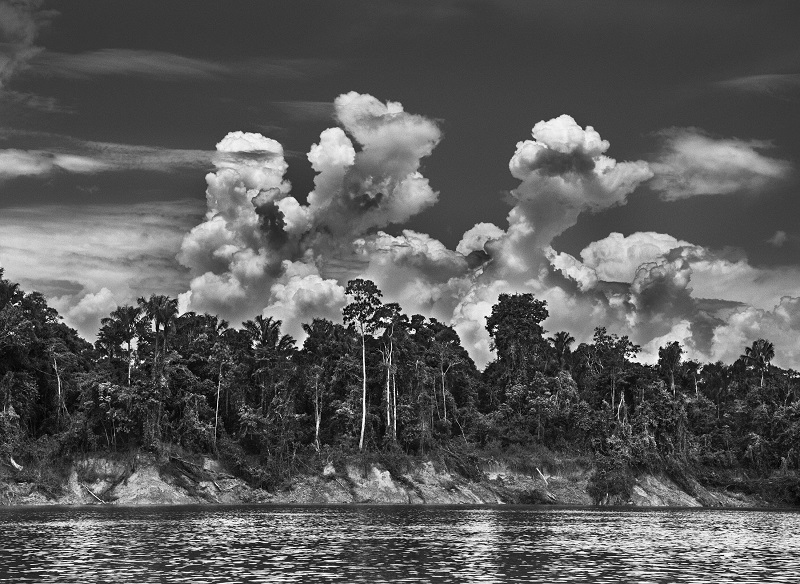
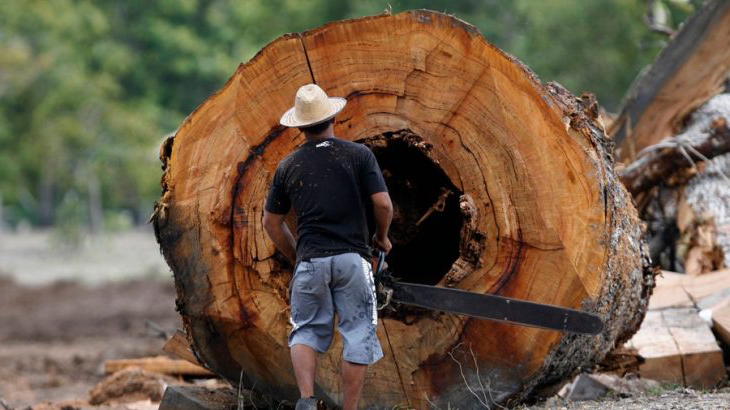
Na capital de Rondônia, um dos estados que formam a Amazônia brasileira, é possível andar quadras e quadras sem conseguir a sombra protetora de uma árvore. Os carros parecem ter saído da fábrica sem o botão de “desliga” do ar-condicionado, uma companhia inseparável graças a uma lógica de ocupação do espaço que tem na floresta uma inimiga a ser suprimida.
O frigorífico da JBS, uma das maiores produtoras de carne do mundo, estava a poucos metros do aeroporto, mas nunca me atentei a ele. Toda vez que eu cruzava o estado de norte a sul, sentia a desolação de ver soja, soja, soja e boi onde antes, em algum momento do qual não fui testemunha, deveria haver mata, mata e mata. Os povos ribeirinhos, sim, tinham lembrança dos tempos nos quais as terras eram deles, mas também não eram de ninguém: não havia cercas, dinheiro, pressões.
“Quem estava antes tinha outra visão da terra. Não se preocupava em ter documento da terra. São populações tradicionais que têm a visão de coletar o que a terra tem para oferecer.” Quando conversamos, em 2014, Maria Petronila era coordenadora da Comissão Pastoral da Terra (CPT), uma organização vinculada à Igreja Católica que foi fundamental na articulação de resistências camponesas Brasil afora.
A ditadura (1964-85) mudou radicalmente a situação. Enormes extensões foram distribuídas a latifundiários, e porções pequenas e médias a camponeses. Em ambos os casos, partindo da ideia de um “vazio demográfico” que só existia se os indígenas e os povos tradicionais fossem considerados um nada. Nesse momento, quem ganhava um lote era obrigado a desmatá-lo em pelo menos 50%. Ou seja, a derrubada da Amazônia foi uma política de Estado. E, então, o caminho ficou aberto – primeiro para o boi, que é uma ótima forma de ocupar uma terra, e depois para os grãos.

Ex-integrante do Conselho Indigenista Missionário, filha de seringueiros, Petronila testemunhou como a chegada de pessoas interessadas em promover uma agricultura nos moldes tradicionais provocou um rebuliço na população fixada em Rondônia. “Minha mãe dizia: ‘Pra que eu quero terra? Só preciso de sete palmos pra enterrar. Ou pode jogar no rio que está muito bom’. Eu venho de uma cultura que achava muito estranho vender arroz, feijão, uma galinha caipira. Todo mundo criava. Então, passava alguém, a gente dava. Não sabia o que era vender as coisas.”
Quando rodei por Vilhena, no sul de Rondônia, uma região muito fértil, fiquei impressionado com o que vi à beira da rodovia que foi fundamental para conectar o estado ao Brasil. Foi isso que registrei no livro Corumbiara, caso enterrado:
Enormes folhas de telha metálica se chocam contra as imensas estruturas nas quais deveriam estar presas. Peim, peim, peim. É o som que se escuta o dia todo naqueles imensos galpões, de mais de cem metros de comprimento por uns 30 de largura. É só o que se escuta. As máquinas estão paradas, os fornos foram desligados. Há pouquíssimos operários circulando por ali, na maior parte do tempo falando baixo, cuidadosos de preservar o sono dos cortes de madeira deixados no local. As dezenas de madeireiras abandonadas à margem da BR 364, em Vilhena, são a história de uma cidade: de um estado: de um país. São a história de ontem: os registros de ponto abandonados em um dos galpões datam de 2008 e 2009, as fotos de mulheres peladas coladas nos armários estão vivas. São um retrato da destruição: foram três décadas para acabar com os cortes nobres de todo o Cone Sul, uma vasta região que hoje não consegue produzir mais que madeira de reflorestamento. São a história de hoje: à medida que acabaram as madeiras, as empresas foram embora, deixando maquinário para trás, e rumaram cada vez mais para o norte do estado, em direção a Porto Velho e ao sul do Amazonas, áreas que nos últimos anos viram crescer os índices de derrubada.
A grande marcha brasileira para o oeste não foi televisionada. À diferença dos Estados Unidos, nosso cinema e nossa literatura não promovem uma disputa entre a narrativa épica da ocupação do território e a denúncia do genocídio. Muitos massacres não têm qualquer registro visual – em muitos casos, não há registro algum.
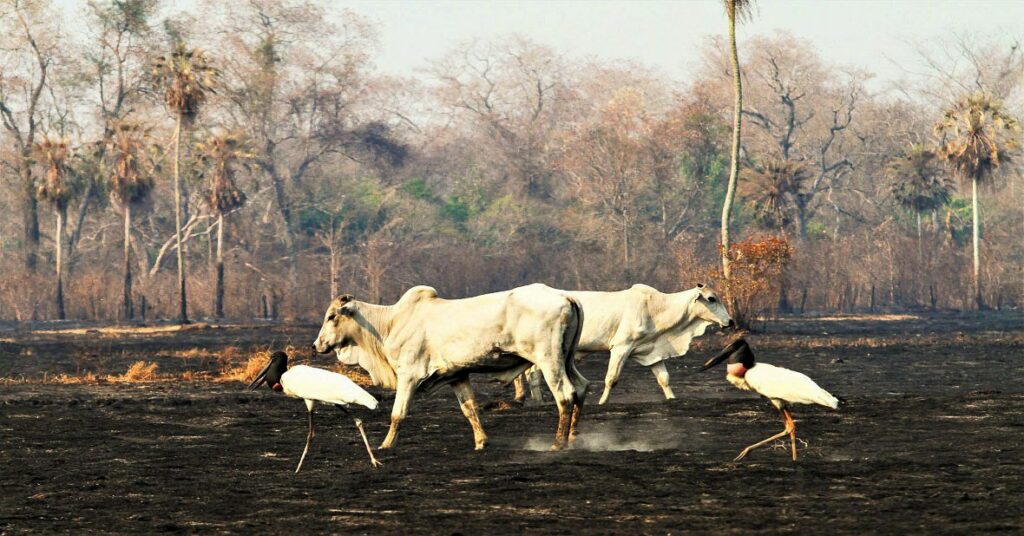
Nos Estados Unidos, a marcha para o oeste massacrou indígenas e búfalos. No Brasil, os primos do búfalo, vacas e bois, são quem domina a terra depois que indígenas e ribeirinhos foram exterminados. Ou antes mesmo que o sejam, como instrumento de pressão sobre as terras que deveriam estar protegidas pelo Estado, livres da ocupação irregular.
O Brasil criou com 27 anos de atraso a Comissão Nacional da Verdade, que funcionou entre 2012 e 2014. Como de praxe em nossa história, a criação do colegiado passou por um acordo com os militares para que fosse investigada toda repressão estatal entre 1946 e 1988, e não apenas durante a ditadura (1964-85). Com base nisso, concluiu-se que 8.350 indígenas foram mortos pelo Estado. “O número deve ser exponencialmente maior, uma vez que apenas uma parcela muito restrita dos povos indígenas afetados foi analisada e que há casos em que a quantidade de mortos é alta o bastante para desencorajar estimativas”, registra o relatório final.
O Brasil sempre foi um país de caranguejos: o modo de colonização português concentrou nossa população nas costas, como, em parte, é até hoje. Foi só no virada para o século 20 que teve início um processo de avanço para o noroeste. Primeiro, foram as linhas de telégrafo, atravessando terras indígenas e mapeando povos tradicionais, em parte com a crença de que essas populações deveriam ser “integradas” a nossa sociedade. Depois, estradas, como a BR 364, que corta Rondônia. A carne. O milho. A soja.
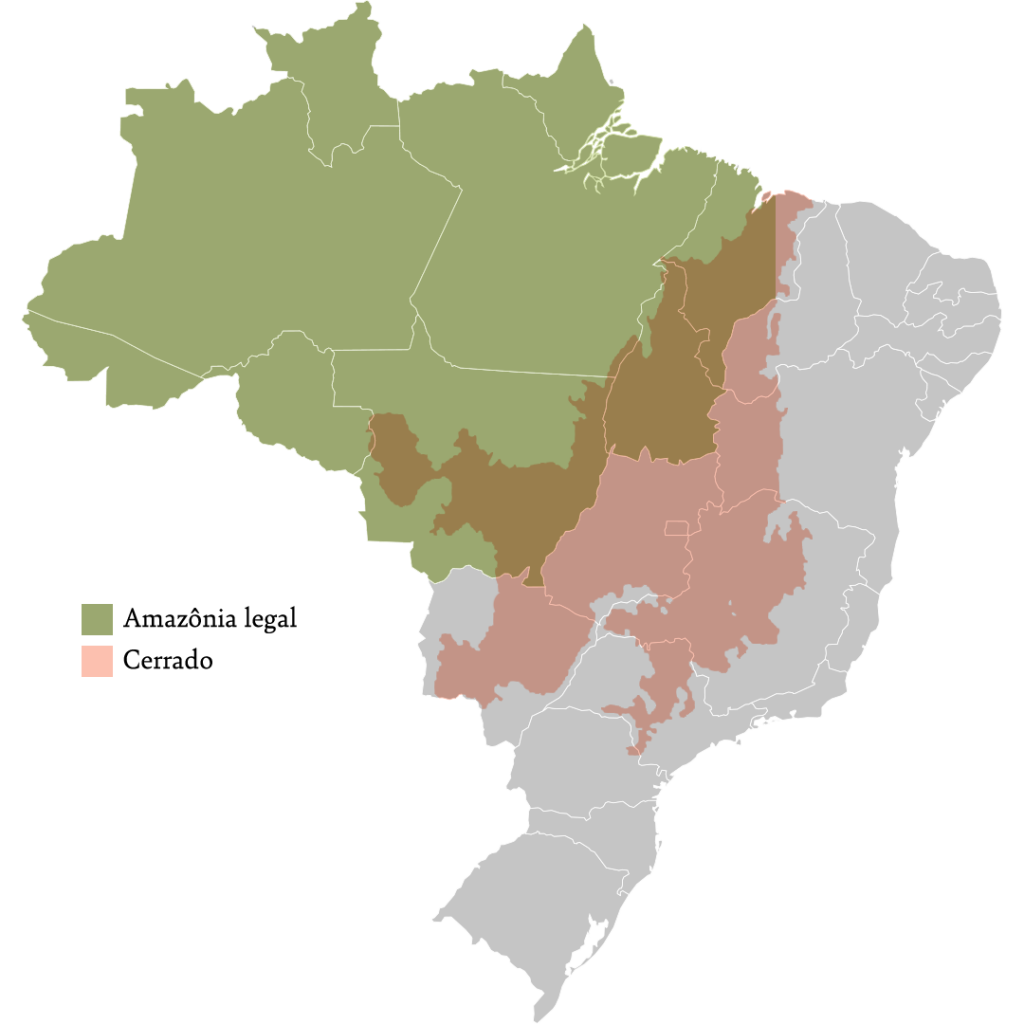
O repórter Marcos Hermanson Pomar, de O Joio e O Trigo, organizou os dados do Instituto Brasileiro de Geografia e Estatística (IBGE) que nos ajudam a entender a grande marcha do boi. Historicamente, a carne era produzida próxima aos grandes centros de consumo do Sudeste. Mas, a partir dos anos 1960, as vacas viram a bússola ao oeste. Primeiro, é como se tivessem pego a reta em direção à Bolívia. Ao chegar perto da fronteira, dobraram à direita, subindo, subindo, subindo, como se quisessem chegar à Venezuela cruzando a floresta. São terras baratas – ou gratuitas, na maior parte, porque fruto de doação ou de grilagem. No primeiro movimento, começamos a dar adeus ao Cerrado, um bioma fundamental que atravessa boa parte do país.
Entre os estados da Amazônia Legal, o Pará vai de um milhão de bois em 1970 para 14 milhões em 2017. O Mato Grosso, de nove milhões para 24 milhões. Rondônia, de 23 mil para quase 10 milhões. Hoje, a indústria brasileira abate 3,8 bilhões de frangos ao ano, o que dá espantosas 19 aves por pessoa. E mais 32 milhões de bois e 46 milhões de porcos.
A região Centro-Oeste dobrou o plantel de bovinos desde 1985, e hoje concentra 34% das nossas 214,7 milhões de cabeças – sim, o Brasil tem um boi por habitante. Já a região Norte, onde está a maior parte da Amazônia, quadruplicou o número de cabeças nesse mesmo período.

Os bois é que são os donos dos nossos principais biomas. Enquanto as aves e os porcos foram confinados, os bovinos seguem sendo criados de forma extensiva no Brasil. Porque, em parte, eles servem para especular sobre a terra, ocupá-la à espera do próximo perdão governamental à grilagem, que é como chamamos o processo de uso ilegal de uma área.
Em 2005, São Félix do Xingu, no meio da Amazônia, já tinha um dos maiores rebanhos bovinos do Brasil, mas a maior parte dos grandes produtores estava no Centro-Oeste. Hoje, dos cinco maiores municípios, três estão no Norte. Sem exceção, essas maiores zonas de produção são, também, áreas de ecossistemas essenciais e frágeis.
Onde há bois, há frigoríficos. As unidades de abate também empreenderam a grande marcha ao oeste, arrastando consigo acidentes de trabalho. Nossa investigação mostrou que, nos 206 pequenos municípios que abrigam frigoríficos, o índice de acidentes laborais é 70% maior que a média, e 212% maior que o de cidades de mesmo porte.
O boi nunca estaria completo sem os grãos. Nos anos 1970, a Empresa Brasileira de Pesquisa Agropecuária (Embrapa) consegue uma façanha tecnológica: criar uma variedade de soja que prospera no Cerrado. Uma área marcada por grandes períodos de seca e por uma vegetação plenamente adaptada a essas condições hostis.
A soja foi de praticamente nada nos anos 1970 para a terceira produção brasileira em valor em meados da década de 1990. Mas o que aconteceu depois… entre 1995 e 2019, o valor cresceu em 3.449%. A área colhida triplicou, de 11 milhões para 35 milhões de hectares. Ancorada no grão, Mato Grosso ultrapassou São Paulo no PIB do agronegócio. O município de Sorriso transformou-se no mais lucrativo do país em termos agrícolas, tendo produzido, sozinho, 2,1 milhões de toneladas de soja.

Mas existe uma clara migração rumo ao Norte, rumo à ex-Amazônia. A região Norte já responde por metade do volume de soja do país, tendo ultrapassado o Centro-oeste (onde fica o Mato Grosso). Pará e Rondônia lideram esse movimento. Claramente, estamos caminhando das bordas da floresta para o centro.
Em Porto Velho, eu via os efeitos da construção das usinas hidrelétricas irmãs, Jirau e Santo Antônio. Um projeto da ditadura que os governos Lula-Dilma se encarregaram de tirar do papel na década passada. A energia não serve de nada aos povos do Norte, e é transferida ao Sudeste por enormes torres que cortam Rondônia de ponta a ponta. Naquela época, os pescadores já não podiam subir alguns trechos do rio Madeira, e se queixavam do desaparecimento de muitas espécies de peixes.
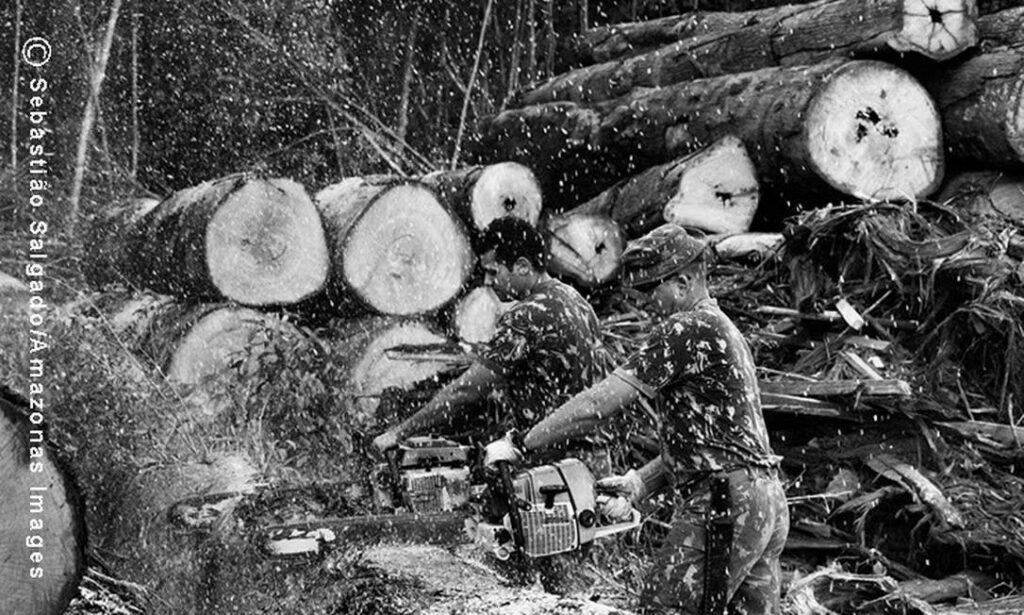
No pacote de obras, especulava-se sobre a pavimentação da BR-319, uma rodovia que liga a capital de Rondônia a Manaus, cortando um dos trechos melhor conservados da floresta – especulação, no vocabulário amazônico, é sinônimo de desmatamento. De novo, um projeto da ditadura. Mas faltou a Dilma o ímpeto autoritário necessário para levar adiante a iniciativa, algo que Jair Bolsonaro não teve dúvidas em resolver.
Na outra ponta da frente de expansão da agropecuária, perdi as contas de quantas vezes ouvimos falar em “Matopiba”, expressão que designa o cinturão da soja formado entre os estados de Maranhão, Tocantins, Piauí e Bahia, uma imensa área de Cerrado por onde avança o agronegócio – os 73 milhões de hectares equivalem à soma de Bélgica e Holanda.
É o Século da Soja. Na avenida principal de Vilhena, um comércio de luxo que contrasta com todo o entorno. Joalherias, revendedoras de carros, restaurantes e bares bem instalados. Vejo que agora, cinco anos mais tarde, há também um shopping: as famílias dos latifundiários, mesmo que só de passagem, precisam das distrações da cidade grande, acostumadas que estão a ignorar os passeios oferecidos pela natureza – sinônimos do atraso.
O século 21 marca o momento de consolidação do conceito do agronegócio e das forças políticas que o representam. O país nasceu e foi criado para os ruralistas, mas não havia uma articulação entre as várias cadeias para serem uma coisa só. Para serem o “agro”, como querem ser chamados. O antropólogo Caio Pompeia, autor de A formação política do agronegócio (Editora Elefante, lançamento em 2021), recorda que, antes, cafeicultores, pecuaristas, sojicultores, fabricantes de fertilizantes, a indústria de comida-porcaria, cada um estava em seu canto. Mas, nos anos 1980 e 1990, a expressão “agronegócio” é importada em definitivo dos Estados Unidos, e tem início uma articulação que no começo do século 21 ficaria mais, mais, mais clara.
O setor nomeia o ministro da Agricultura de Lula. E cria o que hoje conhecemos como “bancada ruralista”, uma força política com controle sobre um terço ou mais dos assentos do Legislativo, com capacidade para derrubar Dilma e ser fiadora do governo ilegítimo de Michel Temer.
Mas, então, vem Jair Bolsonaro. E, também pela primeira vez, o agronegócio fica à esquerda do governo. Pompeia conta algo que muita gente não viu: enquanto os líderes dos setores tradicionais do agronegócio apostavam em eleger um presidente de direita, no interior profundo do Brasil se articulava uma campanha para eleger um sujeito de extrema direita. Depois de muito tempo, voltamos a ouvir falar da União Democrática Ruralista, uma entidade que agrupa o que de mais retrógrado pode haver num setor da sociedade “naturalmente” retrógrado.
Em Rondônia, eu notava que havia algo diferente acontecendo do ponto de vista do pensamento político. Havia uma agenda política que não dialogava com a sensatez, que se produzia na base do achismo, com uma forte influência religiosa. Eram pensamentos por vezes desconexos, delirantes, mágicos. Em pequenas comunidades, de duas ou três mil pessoas, havia 10, 15, 20 igrejas evangélicas. Justamente num estado no qual a igreja católica havia sido fundamental para articular os camponeses em busca de reforma agrária e de contestações ao latifúndio. Pessoas que haviam conquistado um pedaço de chão com base em mobilização agora aderiam a uma lógica de que nada havia a fazer: de que tudo depende do desígnio de Deus.
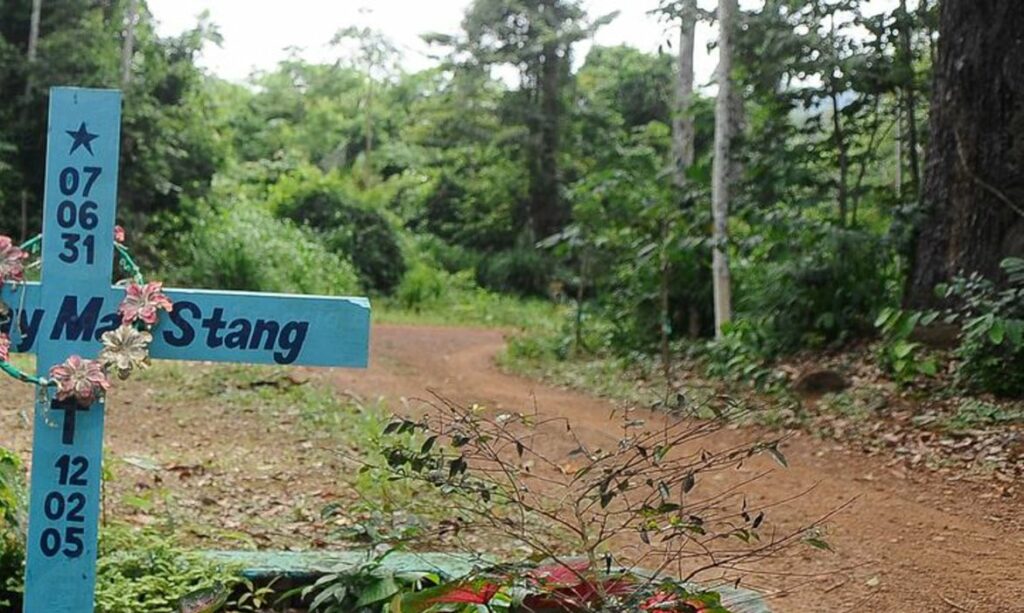
Esse encontro entre religião e política formou um projeto de poder: o avanço da soja e da pecuária forja um matrimônio de interesses com Deus – ou em nome dele. Dessa vez, invertendo a mão dos fluxos históricos: é do interior que surge um projeto político que avança em direção à costa. Dois anos mais tarde, caminhei alguns metros desde a minha casa, no centro de São Paulo, para admirar, espantado, uma marcha gigantesca de pessoas vestidas de verde e amarelo que juravam que o Brasil estava sob uma ditadura comunista. Aconteceu o que eu (muita gente) jamais poderia esperar: aquele pensamento delirante, que até então eu atribuía a pequenos grupos, havia crescido debaixo do nosso nariz.
O bolsonarismo floresceu entre os homens brancos, de classe média, de cidades médias, de formação escolar média. É dialogando com esse eleitor, que sempre se sentiu esquecido, que se cria a base de um pensamento que leva o Brasil a uma agenda do século 16. À diferença dos antecessores, Bolsonaro se faz na base do ressentimento, do ódio, do outro como ameaça, e não na base da promessa do futuro. Não é coincidência que a eleição dele se produza no momento em que a soja toma o topo da balança comercial brasileira, aparentemente para não sair de lá tão cedo. Já não se trata de um país agroindustrial: é algo ainda mais primitivo que a exportação de carnes que, bem ou mal, passaram por algum processamento: é a ração de animais que serão transformados em carne.
A desindustrialização do Brasil já andava a galope. Mas é sobre o cavalo de Bolsonaro que empreendemos uma viagem para os pensamentos mais crus e primitivos que a lógica colonial nos presenteou. Como em tudo, na economia Bolsonaro só sabe usar a arquitetura da destruição: é na mineração, no uso predatório da natureza que ele encontra a resposta para tudo – inclusive para o prazer.
Os brasileiros consomem, em média, 20,7 quilos de carne ao ano, ou quatro bilhões de quilos. Mas existe uma diferença clara, segundo a Pesquisa de Orçamentos Familiares: quem recebe menos de dois salários mínimos come quase a metade do que a porção mais rica da população. Ao longo do século, o consumo se reduziu em praticamente todo o país, mas há uma exceção: o Centro-Oeste, a região por onde a soja e o boi avançaram para chegar à Amazônia. Olhando para o mapa de votação por municípios, e olhando para as cidades por onde avança o agronegócio, encontra-se uma clara intersecção. A grande marcha brasileira para o oeste foi uma marcha conservadora, que espalhou um idioma específico, retrógrado, raivoso.
Como diz o pensador argentino Horacio Machado Araoz, no livro Genealogia da mineração contemporânea,
Retrospectivamente, o extermínio originário das populações nativas de Nossa América e o recurso antieconômico e abusivo à violência funcionaram como verdadeiros atos de fundação, acontecimentos pedagógico-políticos nos quais essa aventura da matéria vivente cientificamente nomeada como “homo sapiens” começa a adentrar-se numa aprendizagem cada vez mais sistemática de um saber perverso: a arte da crueldade e da cobiça como práticas aparentemente infinitas e como sentido da existência.
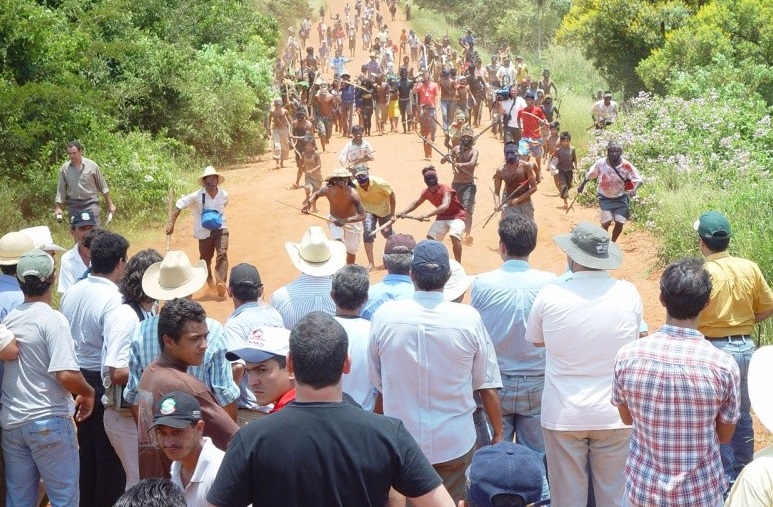
A vantagem de viver nos tempos de Bolsonaro é que a arte da crueldade e da cobiça fica nua. Não há intenção alguma de fantasiá-la, de ocultá-la, de apresentá-la sob uma roupagem moderna. O Brasil arde em chamas há dois anos seguidos, sabemos que os incêndios são criminosos, e não há nada que se possa fazer para deter a marcha da insanidade.
É difícil escolher qual a fala mais grotesca do presidente a respeito dos povos indígenas. Pinço uma, entre tantas possíveis: “O índio mudou, tá evol… Cada vez mais, o índio é um ser humano igual a nós. Então, vamos fazer com que o índio se integre à sociedade e seja realmente dono da sua terra indígena, isso é o que a gente quer aqui.” As terras indígenas são um dos principais espaços de preservação das matas. É sobre elas que Bolsonaro sonha em promover garimpos, em criar animais, em plantar soja.
Nos primeiros meses da pandemia, a divulgação de um vídeo completo de uma reunião ministerial, determinada pela Justiça, não deixou qualquer margem a dúvidas: estamos nas mãos de um governo de paranóicos e delirantes. O ministro do Meio Ambiente, Ricardo Salles, afirmou que era hora de aproveitar a “distração” criada pela Covid-19 para “passar a boiada”. A arte da crueldade e da cobiça: nua.

É inviável sistematizar tudo o que foi feito nos últimos dois anos. O resumo é a retirada total do Estado do papel de regulação de corporações, o sinal verde para a destruição dos nossos ecossistemas e o aprofundamento ultraveloz de uma matriz econômica que no século 19 já seria ultrapassada. Tudo isso sob o aplauso de uma parcela gigantesca da população que realmente acredita que estamos caminhando em direção ao futuro.
E quando a floresta acabar, o que será de nós? Um estudo de 2014 calcula que, de pé, a Amazônia vale, por ano, o equivalente ao nosso PIB. Deitada, ela vale o mesmo que qualquer outra região do país: o quanto conseguirmos arrancar de grãos ou de carne.
Mas esse não é um problema para as pessoas que estão aproveitando o momento para desmatar e atear fogo a tudo. Só importa o hoje. Só importa o eu. Só importa o boi. Só importa a soja. Como disse Jair Bolsonaro quando tentou colocar o filho como embaixador do Brasil nos Estados Unidos: “Se puder dar um filé mignon para o meu filho, eu dou.” A arte da crueldade e da cobiça: nua.

Gostou do texto? Contribua para manter e ampliar nosso jornalismo de profundidade: OUTROSQUINHENTOS
Assinar:
Postagens (Atom)