sábado, 21 de julho de 2018

When the US Invaded Russia

By Jeff KleinSpecial to Consortium News
Amid the bi-partisan mania over the Trump-Putin Summit in Helsinki, fevered, anti-Russian rhetoric in the United States makes conceivable what until recently seemed inconcievable: that dangerous tensions between Russia and the U.S. could lead to military conflict. It has happened before.
In September 1959, during a brief thaw in the Cold War, Nikita Khrushchev made his famous visit to the United States. In Los Angeles, the Soviet leader was invited to a luncheon at Twentieth Century-Fox Studios in Hollywood and during a long and rambling exchange he had this to say:
Your armed intervention in Russia was the most unpleasant thing that ever occurred in the relations between our two countries, for we had never waged war against America until then; our troops have never set foot on American soil, while your troops have set foot on Soviet soil.”
These remarks by Khrushchev were little noted in the U.S. press at the time – especially compared to his widely-reported complaint about not being allowed to visit Disneyland.  But even if Americans read about Khrushchev’s comments it is likely that few of them would have had any idea what the Soviet Premier was talking about.
But Soviet – and now Russian — memory is much more persistent.  The wounds of foreign invasions, from Napoleon to the Nazis, were still fresh in Russian public consciousness in 1959 — and even in Russia today — in a way most Americans could not imagine.  Among other things, that is why the Russians reacted with so much outrage to the expansion of NATO to its borders in the 1990’s, despite U.S. promises not to do so during the negotiations for the unification of Germany.
The U.S. invasion Khrushchev referred to took place a century ago, after the October Revolution and during the civil war that followed between Bolshevik and anti-Bolshevik forces, the Red Army against White Russians.  While the Germans and Austrians were occupying parts of Western and Southern Russia, the Allies launched their own armed interventions in the Russian North and the Far East in 1918. 
The Allied nations, including Britain, France, Italy, Japan and the U.S., cited various justifications for sending their troops into Russia: to “rescue” the Czech Legion that had been recruited to fight against the Central Powers; to protect allied military stores and keep them out of the hands of the Germans; to preserve communications via the Trans-Siberian Railway; and possibly to re-open an Eastern Front in the war.  But the real goal – rarely admitted publicly at first—was to reverse the events of October and install a more acceptable Russian government. As Winston Churchill later put it, the aim was to “strangle the Bolshevik infant in its cradle.”
In addition to Siberia, the U.S. joined British and French troops to invade at Archangel, in the north of Russia, on September 4, 1918.
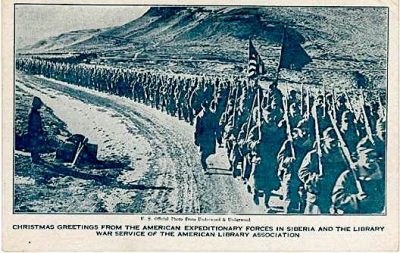
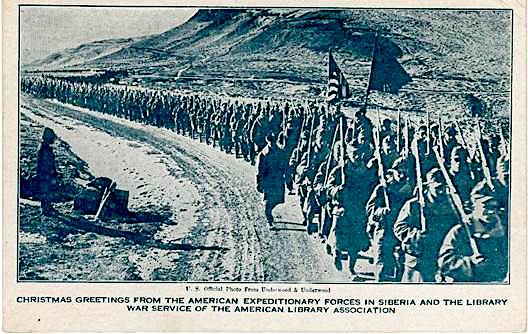
In July 1918, U.S. President Woodrow Wilson had personally typed the “Aide Memoire” on American military action in Russia that was hand-delivered by the Secretary of War at the beginning of August to General William Graves, the designated commander of the U.S. troops en route to Siberia. Wilson’s document was curiously ambivalent and contradictory. It began by asserting that foreign interference in Russia’s internal affairs was “impermissible,” and eventually concluded that the dispatch of U.S. troops to Siberia was not to be considered a “military intervention.”
The Non-Intervention Intervention
But the American intervention began when U.S. soldiers disembarked at Vladivostok on August 16, 1918.  These were the 27th and 31st infantry regiments, regular army units that had been involved in pacification of U.S.-occupied Philippines.  Eventually there were to be about 8,000 U.S. troops in Siberia.
Judging from his memoires, General Graves was puzzled by how different things looked on the ground in Siberia than his vague instructions seemed to suggest.  For one thing, the Czechs hardly needed rescuing.  By the Summer of 1918 they had easily taken control of Vladivostok and a thousand miles of the Trans-Siberian Railway.
For the next year and a half, General Graves, by all appearances an honest and non-political professional soldier, struggled to understand and carry out his mandate in Siberia.  He seems to have driven the U.S. State Department and his fellow allied commanders to distraction by clinging stubbornly to a literal interpretation of Wilson’s Aide Memoire as mandating strict non-intervention in Russian affairs. The general seemed incapable of noticing the broad “wink” with which everyone else understood these instructions.
Graves strove to maintain “neutrality” among the various Russian factions battling for control of Siberia and to focus on his mission to guard the railroad and protect Allied military supplies.  But he was also indiscrete enough to report “White” atrocities as well as “Red” ones, to express his distaste for the various Japanese-supported warlords in Eastern Siberia and, later, to have a skeptical (and correct) assessment of the low popular support, incompetence and poor prospects of the anti-Bolshevik forces.
For his troubles, it was hinted, absurdly, that the General may have been a Bolshevik sympathizer, a charge that in part motivated the publication of his memoirs. 
In the face of hectoring by State Department officials and other Allied commanders to be more active in support of the “right” people in Russia, Graves repeatedly inquired of his superiors in Washington whether his original instructions of political non-intervention were to be modified. No one, of course, was willing to put any different policy in writing and the general struggled to maintain his “neutrality.”
By the Spring and Summer of 1919, however, the U.S. had joined the other Allies in providing overt military support to “Supreme Leader,” Admiral Alexander Kolchak’s White regime, based in the Western Siberian city of Omsk.  At first this was carried out discretely through the Red Cross, but later it took the form of direct shipments of military supplies, including boxcars of rifles whose safe delivery Graves was directed to oversee.
Domestic Intervention 
But the prospects for a victory by Kolchak soon faded and the Whites in Siberia revealed themselves to be a lost cause.  The decision to remove the US troops was made late in 1919 and General Graves, with the last of his staff, departed from Vladivostok on 1 April 1920.
In all, 174 American soldiers were killed during the invasion of Russia. (The Soviet Union was formed on Dec. 28, 1922.)
Interestingly, pressure to withdraw the U.S. troops from Siberia came from fed-up soldiers and home-front opinion opposing the continued deployment of military units abroad long after the conclusion of the war in Europe. It is notable that during a Congressional debate on the Russian intervention one Senator read excerpts from the letters of American soldiers to support the case for bringing them home.
Then, as in later U.S. foreign interventions, the soldiers had a low opinion of the people they were supposed to be liberating.  One of them wrote home on July 28, 1919 from his base in Verkhne-Udinsk, now Ulan Ude, on the southern shore of Lake Baikal:
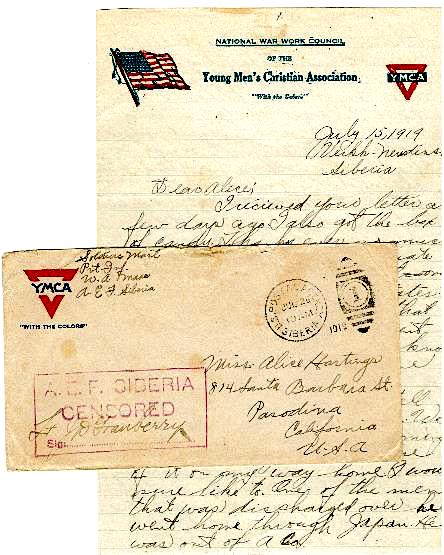
Letter home for U.S. soldier during invasion of Russia
“Life in Siberia may sound exciting but it isn’t.  It’s all right for a few months but I’m ready to go home now. . .  You want to know how I like the people?  Well I’ll tell you, one couldn’t hardly call them people but they are some kind of animal.  They are the most ignorant things I ever saw.  Oh, I can get a word of their lingo if they aren’t sore when they talk.  They sure do rattle off their lingo when they get  sore. These people have only one ambition and that is to drink more vodka than the next person.”
Outside of the State Department and some elite opinion, U.S. intervention had never been very popular.  By now it was widely understood, as one historian noted, that there may have been “many reasons why the doughboys came to Russia, but there was only one reason why they stayed: to intervene in a civil war to see who would govern the country.”
After 1920, the memory of “America’s Siberian Adventure,” as General Graves termed it, soon faded into obscurity.  The American public is notorious for its historic amnesia, even as similar military adventures were repeated again and again over the years since then.
It seems that we may need to be reminded every generation or so of the perils of foreign military intervention and the simple truth asserted by General Graves: 
. . .there isn’t a nation on earth that would not resent foreigners sending troops into their country, for the purpose of putting this or that faction in charge.  The result is not only an injury to the prestige of the foreigner intervening, but is a great handicap to the faction the foreigner is trying to assist.”
General Graves was writing about Siberia in 1918, but it could just as well have been Vietnam in the 1960s or Afghanistan and Syria now. Or a warning today about 30,000 NATO troops on Russia’s borders.
Jeff Klein is a retired local trade union president who writes frequently about international affairs and especially the Middle East.  The postcard and soldier’s letter are in his personal collection.

quinta-feira, 19 de julho de 2018

C’est ainsi que Poutine est sorti victorieux d’Helsinki

Par Nasser Kandil
Il était clair qu’à la base, les décideurs américains, en permettant la tenue d’un sommet avec le président russe Vladimir Poutine, voulaient que leur président évite de se laisser emporter par les tentatives de Poutine de l’attirer sur un terrain où la Russie apparaîtrait comme un partenaire à part entière dans la résolution des dossiers et crises internationaux en suspens. Ce serait un aveu de la fin de l’unilatéralisme par lequel Washington mène sa politique dans le monde. Ce qui était demandé, c’est la reconnaissance d’un partenariat partiel dans des dossiers où la Russie a une influence certaine, en particulier la Syrie et l’Ukraine, et le marchandage dans ces dossiers par la concession d’une victoire russe en Syrie contre la défaite de l’Iran, et l’allègement des sanctions contre l’adhésion russe à une solution conforme à la vision américaine en Ukraine.
La conférence de presse tenue par les deux présidents après le sommet a clairement révélé que le sommet a réuni deux pays détenant tous les dossiers du monde, et la Russie a semblé être l’État le plus important et le plus influent, et le partenaire désormais incontournable dans toutes les politiques internationales. Les sujets qui ont été abordés à la conférence sont toutes des questions  mondiales, et cela signifie un assentiment américain, le premier depuis la chute du mur de Berlin et l’effondrement de l’Union Soviétique, que le temps de l’unilatéralisme est révolu et que l’alliance que le président russe est venu représenter au sommet est un partenaire à part entière dans la gestion du monde, ses économies et ses politiques, et la réalisation de la sécurité et de la paix en son sein.
Le président russe a réussi à éviter tout compromis sur ce qu’il considère comme des réalisations russes dans le dossier ukrainien, en particulier le rattachement de la Crimée, offrant au président américain l’occasion de souligner à ses adversaires étasuniens qu’il a exprimé son opinion divergente. Le président russe a également réussi à imposer publiquement, et avec le consentement américain, son partenariat dans la poursuite des négociations dans le dossier coréen, alors que l’administration américaine avait tendance à en faire un accord bilatéral américano-coréen. Il a également réussi à confirmer l’alliance qui le lie à l’Iran en défendant l’accord sur son dossier nucléaire et en le décrivant comme le pays le plus respectueux des normes de l’Agence internationale de l’énergie atomique, allant même jusqu’à ne pas concéder au président américain un seul mot indiquant une restriction de la présence iranienne dans les dossiers régionaux, et particulièrement en Syrie, et se contentant de lui laisser le loisir d’appeler à resserrer les pressions sur l’Iran, comme sujet controversé avec le président russe.
Dans le contexte syrien, il est clair que l’acceptation américaine de la victoire russe et celle du président syrien n’a pas été rétribuée. A la conférence de presse, l’insistance de Poutine à poursuivre le processus d’Astana sous les auspices de la Russie, de la Turquie et de l’Iran est le signe de sa détermination à considérer la victoire comme russo-syro-iranienne. Ainsi, le projet de marchandage porté par le président américain s’est évanoui, car il n’est pas question que la Russie accepte la sortie de l’Iran et son transfert dans le camp des vaincus en échange de la reconnaissance de la victoire de la Syrie et de la Russie. Il est encore plus clair que le discours du président russe sur le désengagement dans le Golan, signé en 1974, en tant que cadre qui concerne la Russie, est directement relié à l’exécution des résolutions du Conseil de sécurité, notamment la résolution 338 relative au retrait israélien du plateau du Golan et ce, en opposition à la conception israélo-américaine reliant le désengagement à l’annexion du Golan. Poutine a appréhendé le désengagement dans son cadre international pour les questions de conflit, ce qui lui a permis de l’intégrer dans le cadre global des lois internationales et des résolutions onusiennes pour tous les conflits, en particulier dans la région. Et c’est par ce concept que la Russie est déterminée à s’opposer à la politique américaine unilatérale.
Il apparaît que la force sur laquelle s’est appuyé le président Poutine lors de ses négociations réussies, pour tracer une feuille de route des négociations avec Washington et la concrétisation de divers cadres et organes pour les mener, découle de sa conscience de l’importance des cartes qu’il détient, tant au niveau du dilemme américain en Syrie et ses choix difficiles entre la confrontation de la progression de l’armée syrienne ou le repli face à cette progression sans espoir de compromis qui lui garantirait l’association à ses succès, qu’au niveau de l’éventualité d’un échec en Corée du Nord et ses dangers. Toutefois, et tel qu’il apparaît de la conférence de presse, les deux dossiers les plus importants, qui expliquent la supériorité de Poutine, en dehors de son talent et de ses valeurs intrinsèques, concernent :
  • D’une part, la fâcheuse situation dans laquelle se trouve le président américain avec l’enquête sur l’intervention russe dans les élections américaines, et la capacité de Poutine à présenter un plaidoyer favorable et un témoignage précieux en faveur de Trump
  • D’autre part, la situation économique américaine difficile et l’aptitude de la Russie à offrir des opportunités d’investissement prometteuses pour les entreprises américaines, se traduisant par la constitution d’un groupement d’hommes d’affaires conjoint entre les deux pays ; puis l’annonce de la prédisposition de la Russie à accorder aux Etats-Unis une part du marché pétrolier et gazier européen, sans concurrence des prix et sans guerre commerciale ; ce que Trump a essayé d’obtenir de l’Europe, en pesant de tout son poids, sans succès. Poutine a compris le mot-clé à travers l’attaque de Trump sur le Nordstream qui fournit l’Europe en gaz russe, et lui a tenu un discours qui s’adresse à l’homme d’affaires défendant les intérêts des entreprises américaines ayant investi des milliards de dollars dans l’extraction du pétrole et du gaz de schiste pour leur entrée dans les marchés internationaux.
A travers ce sommet, Poutine a mis en place des connections qui commencent tranquillement par des petits points de départ, en suivant un processus d’apaisement dans les dossiers brûlants, pour enchaîner les succès et marquent le recul des paris américains sur le cloisonnement des dossiers, sur les sanctions et sur l’affrontement de l’alliance formée avec Israël et l’Arabie Saoudite qui affaiblirait l’Iran et l’obligerait à des compromis. Tout désengagement devient de fait une partie du réseau des connections.

 ***

 L’analyse succincte du Général Amine Htaite

Le sommet d’Helsinki a déçu les espoirs de certains et confirmé les attentes d’autres en matière de consensus pour prévenir le conflit et reconnaître les intérêts possibles.
La Russie a arraché une approbation américaine implicite pour son association en tant que partenaire dans les dossiers internationaux et l’uni-polarité mondiale n’est plus. Elle a affirmé son droit d’accès au marché européen, en tenant compte des intérêts américains notamment dans le domaine du gaz.
La Russie a confirmé que la victoire en Syrie n’est pas sujette à dérogation. Le régime continue, les alliés restent, la Syrie est unie, les étrangers doivent partir, et la sécurité d’Israël n’est assurée que par l’exécution de l’accord de désengagement de 1974, et rien d’autre.
La Crimée n’est pas négociable et le monde et l’Ukraine doivent reconnaître ce fait accompli.
2) Quant aux Etats-Unis : Trump a perdu une partie du prestige de la présidence américaine et n’a rien obtenu concernant l’Iran et ses alliés. Le plus important de ce qu’il a pu obtenir est la facilitation russe pour commercialiser le gaz américain en particulier en Europe.
En résumé, sont désappointés ceux qui ont parié sur une victoire américaine en Syrie, ou sur l’isolement de l’Iran et son encerclement régional, ou sur l’engagement de la Russie à satisfaire les exigences d’Israël ou son abandon de la Crimée.
Les dossiers chinois, coréen et européen sont restés flous.

sábado, 14 de julho de 2018

Clarín: EUA manipulam Lava Jato para destruir o Brasil e a AL

Por El Clarín Chile, com tradução da Carta Maior
Num discurso feito em julho deste ano, no qual felicitava a si mesmo, o subprocurador geral estadunidense Kenneth A. Blanco, que dirigia a Divisão Penal do Departamento de Justiça (porque logo o Secretário do Tesouro, Steve Mnuchin, o escolheu para encabeçar a Direção de Investigação sobre Delitos Financeiros), se referiu ao veredito condenatório ditado contra o ex-presidente do Brasil, Lula da Silva, como o principal exemplo dos “resultados extraordinários” alcançados graças à colaboração do Departamento de Justiça (DOJ, por sua sigla em inglês) com os promotores brasileiros na operação “anti corrupção” chamada Lava Jato.
A unidade da Divisão Penal do DOJ que colabora com a Lava Jato é a Seção de Fraudes. De novembro de 2014 até junho de 2017, quem dirigia a Seção de Fraudes do DOJ era ninguém menos que Andrew Weissman. Ao deixar essa função, ele foi transferido e passou a formar parte do grupo de choque contra Trump encabeçado pelo Procurador Especial do FBI, Robert Mueller. Weissman tem sido, há muito tempo, o principal assessor de Mueller, e seu histórico de conduta indevida lhe valeu o apelido de “pitbull judicial de Mueller”.
Agora que se está ficando evidente o assalto judicial de Mueller contra a Presidência dos Estados Unidos, com cada vez mais membros de sua equipe ficando expostos por sua corrupção e atos ilegais, é de se esperar que sua operação latino-americana, a Lava Jato, terá a mesma sorte.
Como se sabe, Weissman foi retirado da equipe de caça às bruxas porque transcendeu à luz pública sua parcialidade a favor de Hillary Clinton. Agora cada vez que se menciona a Weissman na imprensa estadunidense é para fazer referência à profunda corrupção que inunda o Departamento de Justiça e o FBI.
As ex-presidentas do Brasil e da Argentina, Dilma Rousseff e Cristina Fernández de Kirchner, respectivamente, denunciaram na semana passada que os líderes nacionalistas e progressistas de todo o continente estão sendo submetidos sistematicamente ao que denominam lawfare, o uso da lei como arma de guerra, com o propósito de impor mudanças de governo e instalar chefes de Estado comprometidos com as políticas de austeridade neoliberal que vão destruindo a região. O discurso de Blanco demonstra que por trás do tal lawfare estão os mesmos interesses imperiais que buscam dar um golpe de Estado em seu próprio país, depor o presidente Donald Trump do seu cargo e instalar alguém ainda mais fiel aos interesses do mercado.
Em discurso mais recente, Blanco se jactou do papel do DOJ em toda esta farsa, durante um evento chamado Diálogo Interamericano, na palestra “Lições do Brasil: Crise, corrupção e cooperação global”. Na ocasião, Blanco deu as boas-vindas ao seu amigo Rodrigo Janot, quem foi há até pouco tempo, e durante anos, o Procurador Geral da República do Brasil, e um dos principais sicários da Lava Jato.
“É difícil imaginar, na história recente, uma melhor relação de cooperação que esta entre o Departamento de Justiça dos Estados Unidos e os procuradores brasileiros. Esta cooperação nos ajudou de forma substancial com uma série de temas públicos que agora estão resolvidos, e continuamos juntos em uma série de investigações”, afirmou Blanco.
“A cooperação entre o DOJ e o Ministério Público brasileiro levou a resultados extraordinários. Só em 2016, por exemplo, o FBI e a Lava Jato estiveram cooperando e se coordenaram nas resoluções de quatro casos relacionados com a Lei sobre Práticas Corruptas no Exterior (FCPA por sua sigla em inglês), ligado às empresas Embraer, Rolls Royce, Braskem e Odebrecht. O caso da Odebrecht em particular é notável, devido ao seu alcance e sua extensão”, continuou Blanco, que também lembrou que “os procuradores brasileiros conseguiram um veredito condenatório contra o ex-presidente Lula da Silva, acusado de receber subornos da empreiteira OAS em troca de contratos com a Petrobras. Casos como este são os que colocaram o Brasil no topo do ranking dos países que trabalham para combater a corrupção tanto dentro quanto fora do país”.
Blanco revelou, nesse discurso, que a cooperação entre o DOJ e os procuradores brasileiros é tão grande que “operam inclusive fora dos processos formais, como nos tratados de assistência judicial mútua”, que consistem em simples ligações telefônicas de uns para outros, para trocar informações ou solicitar evidências driblando as formalidades legais quando é necessário.
Procuradores e promotores de toda a região entram e saem dos escritórios do Departamento de Justiça estadunidense (o mexicano Raúl Cervantes, quem Blanco considera um “bom amigo”, a panamenha Kenia Porcell”, e muitos outros na Colômbia, no Equador e em vários países do continente) para falar sobre as ações “contra a corrupção”, segundo o discurso do subprocurador. Embora o mesmo não tenha citado os juízes Claudio Bonadio e Sérgio Moro – responsáveis pelas condenações a Lula da Silva e Cristina Fernández de Kirchner, respectivamente – sabe-se que ambos também são parte desse esquadrão de elite judiciário, e figuras centrais da nova política de choque para o continente.

sábado, 7 de julho de 2018

Ce que prépare Donald Trump

Ce que prépare Donald Trump

Après avoir observé les références historiques de Donald Trump (le compromis constitutionnel de 1789, les exemples d’Andrew Jackson et de Richard Nixon) et la manière dont ses partisans perçoivent sa politique, Thierry Meyssan analyse son action anti-impérialiste. Il ne s’agit pas pour le président états-unien d’opérer un retour en arrière, mais au contraire d’abandonner les intérêts de la classe dirigeante transnationale afin de développer son économie nationale.
 | DAMAS (SYRIE)  

Le problème

En 1916, durant la Première Guerre mondiale, Lénine analysait les raisons qui conduisirent à l’affrontement entre les empires de son époque. Il écrivit alors : L’impérialisme, stade suprême du capitalisme. Dans cet ouvrage, il précisait ainsi sa pensée : « L’impérialisme est le capitalisme arrivé à un stade de développement où s’est affirmée la domination des monopoles et du capital financier, où l’exportation des capitaux a acquis une importance de premier plan, où le partage du monde a commencé entre les trusts internationaux et où s’est achevé le partage de tout le territoire du globe entre les plus grands pays capitalistes ».
Les faits ont confirmé la logique de concentration du capitalisme qu’il décrivait. Elle a substitué en un siècle un nouvel empire aux précédents : « L’Amérique » (à ne pas confondre avec le continent américain). À force de fusions-acquisitions, quelques sociétés multinationales ont donné naissance à une classe dirigeante globale que l’on peut voir se congratuler chaque année en Suisse, à Davos. Ces gens ne servent pas les intérêts du peuple états-unien et ne sont d’ailleurs pas nécessairement états-uniens, mais instrumentent les moyens de l’État fédéral US pour maximiser leurs profits.
Donald Trump a été élu comme président des États-Unis sur sa promesse de revenir à l’état antérieur du capitalisme, celui du « rêve américain » par la libre-concurrence. On peut certes poser a priori, comme Lénine, que ce rétablissement est impossible, le nouveau président s’est pourtant engagé dans cette voie.
Le cœur du système capitaliste impérial est exprimé par la doctrine du Pentagone, formulée par l’amiral Arthur Cebrowski : le monde est désormais divisé en deux. D’un côté des États développés et stables, de l’autre des États pas encore intégrés à la globalisation impériale et donc voués à l’instabilité. Les forces armées US ont pour mission de détruire les structures étatiques et sociales des régions non-intégrées. Depuis 2001, elles ont patiemment détruit le « Moyen-Orient élargi » et s’apprêtent aujourd’hui à faire de même dans le « Bassin des Caraïbes ».
Force est de constater que la manière dont le Pentagone appréhende le monde s’appuie sur les mêmes concepts que ceux utilisés par des penseurs anti-impérialistes comme Immanuel Wallerstein, Giovanni Arrighi ou Samir Amin.

La tentative de solution

L’objectif de Donald Trump consiste donc à la fois à réinvestir les capitaux transnationaux dans l’économie US et à ramener le Pentagone et la CIA de leur fonction impérialiste actuelle à la Défense nationale. Pour ce faire, il doit se retirer des traités commerciaux internationaux et dissoudre les structures intergouvernementales qui fixent l’ordre ancien.
Défaire les traités commerciaux internationaux
Dès les premiers jours de son mandat, le président Trump a retiré son pays de l’Accord de partenariat transpacifique qui n’avait pas encore été signé. Ce traité commercial avait été conçu au plan stratégique pour isoler la Chine.
Ne pouvant annuler la signature de son pays de traités en vigueur comme l’Accord de libre-échange nord-américain, il a commencé à les détricoter en imposant divers droits de douane qui en violent l’esprit, mais pas la lettre.
Recadrer ou dissoudre les structures intergouvernementales
Nous l’avons souvent relaté ici, les Nations unies ne sont plus un forum pour la paix, mais un instrument de l’impérialisme US dans lequel quelques États continuent à résister. C’était déjà le cas lors de la politique soviétique de la chaise vide (guerre de Corée) et ce l’est à nouveau depuis juillet 2012.
Le président Trump a directement attaqué les deux principaux outils impérialistes au sein de l’Onu : les opérations de maintien de la paix (qui se sont substituées aux missions d’observation prévues à l’origine par la Charte) et le Conseil des droits de l’homme (dont la seule fonction est de justifier les guerres humanitaires de l’Otan). Il a siphonné le budget des premières et a retiré son pays du second. Il vient par contre de perdre l’élection du directeur de l’Organisation internationale pour les migrations, laissant pour le moment le champ libre au trafic mondial des êtres humains. Il ne s’agit évidemment pas pour lui de détruire l’Onu, mais de la recadrer pour la ramener à sa fonction initiale.
Il vient de torpiller le G7. Cette rencontre, initialement prévue pour échanger des points de vue, était devenue à partir de 1994 un outil de la domination impériale. En 2014, il s’est transformé en un instrument anti-Russe ; conformément à ce qui était devenu la nouvelle stratégie des anglo-saxons visant à « faire la part du feu », c’est-à-dire à éviter une Guerre mondiale en délimitant l’empire aux frontières de la Russie et en isolant celle-ci. Le président Trump s’est évertué durant la réunion de Charlevoix à montrer à ses alliés désemparés qu’il n’était plus leur suzerain et qu’ils devraient se débrouiller seuls.
Enfin, après avoir tenté d’utiliser la France pour dynamiter l’Union européenne, il s’est tourné vers l’Italie où il a envoyé Steve Bannon pour créer un gouvernement anti-système avec l’aide de banques US. Rome a déjà fait alliance avec cinq autres capitales contre Bruxelles.
Réinvestir dans l’économie productive
Par diverses mesures fiscales et douanières, rarement votées par le Congrès et plus souvent prises par décret, le président Trump encourage les grandes sociétés de son pays à rapatrier leurs usines dans son pays. Il s’en est immédiatement suivi une reprise économique qui est à peu près la seule chose que la presse lui reconnaisse.
Cependant, on est très loin de constater un recul de la Finance. Probablement celle-ci continue à prospérer en dehors des USA, donc à pomper les richesses du reste du monde.
Réorienter le Pentagone et la CIA
C’est évidemment le plus difficile. Lors de son élection, le président Trump disposa des voix des hommes de troupes, mais pas de celles des officiers supérieurs et généraux.
Donald Trump est entré en politique le 11 septembre 2001. Il a immédiatement contesté la version officielle des événements. Par la suite, il s’est étonné des contradictions du discours dominant : alors que les présidents Bush Jr. et Obama ont déclaré vouloir éliminer les mouvements jihadistes, on a observé au contraire une multiplication drastique et une globalisation du jihadisme durant leurs mandats allant jusqu’à la création d’un État indépendant en Iraq et en Syrie.
C’est pourquoi, dès son entrée en fonction, le président Trump s’est entouré d’officiers ayant une autorité reconnue dans ses armées. C’était pour lui la seule option, à la fois pour prévenir un coup d’État militaire et pour se faire obéir dans la réforme qu’il souhaitait entreprendre. Puis, il a donné carte blanche aux militaires dans leur ensemble pour tout ce qui concerne la tactique sur le terrain. Enfin, il ne manque aucune occasion pour réaffirmer son soutien aux Forces armées et aux services de Renseignement.
Après avoir retiré leurs sièges permanents au président des chefs d’état-major et au directeur de la CIA au sein du Conseil national de sécurité, il a ordonné de cesser de soutenir les jihadistes. Progressivement, on a vu Al-Qaeda et Daesh perdre du terrain. Cette politique se poursuit aujourd’hui avec le retrait du soutien US aux jihadistes au Sud de la Syrie. Désormais, ceux-ci ne forment plus d’armées privées, mais uniquement des groupes épars utilisés pour des actions terroristes ponctuelles.
Dans la même lignée, il a d’abord feint de renoncer à dissoudre l’Otan si celle-ci acceptait d’ajouter à sa fonction anti-Russe, une fonction anti-terroriste. Il commence désormais à montrer à l’Otan qu’elle ne dispose pas de privilèges éternels, comme on l’a vu avec le refus d’accorder un visa spécial pour un ancien secrétaire général. Surtout, il commence à rogner sa fonction anti-Russe. Ainsi négocie-t-il avec Moscou l’annulation des manœuvres de l’Alliance en Europe de l’Est. En outre, il pose des actes administratifs attestant le refus des alliés de contribuer à la hauteur de leurs moyens à la défense collective. De la sorte, il se prépare à faire exploser l’Otan lorsqu’il le jugera possible.
Ce moment n’interviendra que lorsque la destructuration des relations internationales arrivera simultanément à maturité en Asie (Corée du Nord), au Moyen-Orient élargi (Palestine et Iran) et en Europe (UE).
Ce qu’il faut retenir
- Le président Trump n’est absolument pas le personnage « imprévisible » qu’on nous décrit. Bien au contraire, il agit de manière tout à fait réfléchie et logique.
- Donald Trump prépare une réorganisation des relations internationales. Ce changement passe par un bouleversement complet et soudain, dirigé contre les intérêts de la classe dirigeante transnationale.

domingo, 1 de julho de 2018

How Adam Smith would fix capitalism bbb

 Jesse Norman JUNE 22, 20188

 Capitalism in flames, populism and nationalism on the march across Europe, a US president bent on demolishing free trade, a British shadow chancellor calling openly for the overthrow of capitalism itself . . . the 21st century is not going to script. The market system from which global prosperity has emerged over two centuries is now under attack from all sides, its basic legitimacy assailed from the right by critics of unfair competition and crony capitalism, from the left by campaigners against inequality and “market fundamentalism”. More than any other, the Scottish political economist and philosopher Adam Smith stands at the centre of this ideological battlefield, while around him clash competing views of economics, markets and societies. For many on the right of politics, the author of The Wealth of Nations is a founding figure of the modern era: the greatest of all economists; an eloquent advocate of laissez-faire, free markets, the “invisible hand” and the liberty of the individual; and the staunch enemy of state intervention in a world released from the utopian delusions of communism. For many on the left, Smith is something very different: the true source and origin of “market fundamentalism”, homo economicus and the efficient market hypothesis; the prime mover of a materialist ideology that is sweeping the world and corrupting real sources of human value; an apologist for wealth and inequality and human selfishness — and a misogynist to boot. A portrait of Adam Smith by John Kay (1790) © Getty Which, then, is the real Adam Smith? In fact, both these views are hopeless caricatures. Smith was not an advocate of laissez-faire; the phrase “invisible hand” occurs just once in The Wealth of Nations; and he did not oppose all state interventions in markets. Indeed, he positively advocates a range of them, from specific forms of taxation to regulation of the banks. He did not think selfishness was a virtue, and he was not a misogynist; far from originating the idea of “market fundamentalism”, he would have opposed it; and homo economicus and the efficient market hypothesis are later ideas that badly distort Smith’s own views. Industrial capitalism itself, as the combination of freely trading markets and autonomous corporations, is a 19th-century phenomenon, and only emerged two generations after his death. The real Adam Smith is a vastly wiser and more subtle thinker. He forces us to discard the usual simplistic slogans and tired clichés. But more than this: he still has a vast amount to teach us, not merely about economics and markets and trade, but about the deepest issues of inequality, culture and human society facing us today. Far from attacking Smith, we must turn to him again. For we cannot understand, or address, the problems of the modern world without him. © Matthew Cook One thing is clear: Smith is by far the most influential economist who has ever lived. Virtually every great economist of the past two centuries has invoked his name. Every major modern branch of economics, from the so-called neoclassical mainstream to the Austrian and Marxist schools and the more recent offshoots of institutional, developmental and behavioural economics, traces its roots back to Smith. Meanwhile politicians, academics and pub bores around the world have found the authority of The Wealth of Nations and the simplicity of its core ideas an irresistible combination, and routinely draw on them to dignify and adorn their own beliefs or arguments, however dubious they may be. The result has been to obscure Smith’s ideas, and to breed myths without number. For Smith is so intellectually fertile, so multi-faceted and so quotable that he offers constant temptations to over-interpretation or outright theft. Indeed, he can be read as anticipating an astonishing range of contemporary events. One such is the rise of celebrity politics, from the interaction of modern technology with the human disposition to admire the rich and the powerful, and the human capacity for mutual sympathy, both ideas Smith discusses in his less well-known but no less brilliant first book, The Theory of Moral Sentiments. Another is the logic or otherwise of Britain’s departure from the European Union. After all, during the war of independence, Smith argued in relation to the American colonies that Britain faced a clear choice: either to separate entirely from them, or to form an imperial union, in which case sovereignty, and in due course the seat of government itself, would end up slowly being transferred to America. It is no small irony that Smith himself detested controversy. A man of gentle and retiring disposition, he led a life of academic uneventfulness. Born in Kirkcaldy, Fife, in 1723, he went to study first at the university of Glasgow, and then in 1740 at Balliol College, Oxford — which he much disliked. One can understand why, since Balliol at that time was High Church, Tory, factional, costly and Scotophobic; and Smith was Presbyterian, Whiggish, sociable, impecunious and a Scot. It was not a happy combination. Smith left Oxford in 1746, and after a period at home returned to Glasgow as a professor. In 1764 he embarked on an extended tour of France as tutor to the young Duke of Buccleuch, before finally taking a position as a Commissioner of Customs for Scotland. Over 40 years he published The Theory of Moral Sentiments (1759) and An Inquiry into the Nature and Causes of the Wealth of Nations (1776), and very little else. As to his private views, we know very little. In politics he was broadly Whiggish in his belief in the virtues of constitutional monarchy, religious toleration and personal freedom. But he remained remarkably close-lipped about his own political views throughout his life. He was famously absent-minded, once being so engrossed in conversation that he fell into a tanner’s pit. He never married, and he had no children. As far as we know, there were no secret loves, no hidden vices, no undergraduate pranks, no adult peccadilloes: when it comes to juicy personal detail, Smith’s life is a featureless Sahara. © Matthew Cook But if Smith’s life was uneventful, the times he lived in were not; indeed, they were tumultuous. The Union between England and Scotland forged in 1707 was, then as now, a bitterly contested affair. But it proved to be a foundation of modern Scottish nationhood, and it set in motion a transformation that made Scotland one of the tiger economies of the 19th century. Union opened the way for Scotland to leave feudalism behind and become what Smith calls a “commercial society”, based not on personal subordination but on markets and trade. But that process was by no means preordained. After all, in their quest to reclaim power for the Stuart monarchy, which had been dispossessed in 1688, the Jacobites repeatedly rebelled. In their last and greatest revolt, under Bonnie Prince Charlie in 1745, the Jacobites came within 120 miles of London and might have taken the city had they not been tricked by false English intelligence. If they had succeeded, then — who knows? — the entire political and religious settlement of Britain might have changed. However, Scotland’s 18th-century transformation was not merely economic; it was cultural and intellectual as well, and it took the country from the edge to the centre of European thought. What is now known as the Scottish Enlightenment included a dazzling array of thinkers in philosophy, the natural sciences, law, history, and literature as well as political economy, social psychology and ethics — a generation comparable to Dr Johnson, Edmund Burke, Joshua Reynolds, David Garrick, Oliver Goldsmith and Edward Gibbon south of the border. Smith once described the great philosopher-statesman Burke as “the only man, who, without communication, thought on economic subjects exactly as he did”. But Smith’s closest friend and deepest influence was David Hume, and he and Hume — by any measure one of the greatest philosophers of all time — were at the heart of this remarkable Scottish intellectual transformation. They were an unusual pair. Hume, the older man by 12 years, was worldly, open, witty, full of small talk, banter and piercing aperçus, a lover of whist, a gourmand and a flirt; Smith by contrast was reserved, private, considered and often rather austere in his public manner, although he could unwind in private. Hume’s ironic wit and humour make him a biographer’s dream. After his History of England proved to be a tremendous critical and popular success, his publisher entreated him for another volume, only to receive the memorable rebuff: “I have four reasons for not writing: I am too old, too fat, too lazy and too rich.” When at a last dinner before Hume’s death in 1776, Smith complained of the cruelty of the world in taking him from them, Hume said: “No, no. Here am I, who have written on all sorts of subjects calculated to excite hostility, moral, political, and religious, and yet I have no enemies; except, indeed, all the Whigs, all the Tories, and all the Christians.” There are many other such stories. Hume’s thoroughgoing philosophical scepticism had earned him a notorious reputation as an atheist, so much so that he was turned down for academic positions at both Glasgow and Edinburgh universities, to their everlasting later embarrassment. But after Hume’s death, Smith published a warm and loving encomium, which concluded: “Upon the whole, I have always considered him, both in his lifetime and since his death, as approaching as nearly to the idea of a perfectly wise and virtuous man, as perhaps the nature of human frailty will permit.” It was a handsome tribute — to his friend, and to the truth. But it is for his ideas that Adam Smith will be remembered, and it is through his ideas and their impact that Smith lives and breathes today. At the heart of his thought is a — perhaps the — great Enlightenment project. This is to set out what Hume had described as a “science of man”: to give a unified and general account, just as Newton had done with cosmology, of human life in all its major aspects, derived from a few basic propositions but reaching out to cover philosophy, religion, political economy, jurisprudence and the arts as well as the sciences, even language itself. Crucially, this science of man was to be based on observation and experience, and not on natural law, divine inspiration or religious dogma. Smith’s two great published works, The Theory of Moral Sentiments and The Wealth of Nations, are at first glance very different. The first is about moral psychology, the second about political economy; the first was long ignored, the second is probably the most influential and widely quoted work of social science ever written; and neither is read today even by the vast majority of those who quote them. But far from being at odds with each other, as some have thought, the two works can be brought together, alongside Smith’s unpublished writings, to provide a unified, incomplete but still astonishingly fertile and modern account of human behaviour. For Smith, the crucial linking idea is that of the continuous exchange that occurs in all human interaction. This may be the exchange of goods and services in markets. But it can also be the exchange of meanings in language and in other forms of communication. And it can be the exchange of regard or esteem that in Smith’s view underlies the formation of moral and social norms in society. Each of these ideas is of extraordinary importance in its own right, but together they reveal a very different picture to the caricatures. © Matthew Cook First, we need to recognise that The Wealth of Nations is a work of genius not merely because it sets out many of the central intellectual tools of political economy — the division of labour, the idea of market equilibrium, the effects of incentives on behaviour, the benefits of free trade, Smith’s four maxims of taxation, to list just a few — but because Smith is the first person to put markets at the centre of economics itself. Smith is thus the hinge of our economic modernity, just as Burke, with his theory of political parties and representative government, is the hinge of our political modernity. But, second, markets for Smith are very different to those of economists today. They are not the disembodied mathematical constructs of modern economics and policymaking, and his view of individuals is not that of a desiccated economic atomism. Rather — recalling his insights about language and ethics — markets are living institutions embedded in specific cultures and mediated by social norms and trust. They shape and are shaped by their participants, in a dynamic and evolving way. They often have common features, but they are as different from one another as individual humans are: markets for land and labour and capital, asset markets from product markets and all the innumerable rest of them. Yes, markets typically generate economic value, and they are unmatched in their ability to allocate goods and services and encourage innovation and technological improvement. But, third, what matters is not the largely empty rhetoric of “free markets”, but the reality of effective competition. And effective competition requires mechanisms that force companies to internalise their own costs and not push them on to others, that bear down on crony capitalism, rent extraction, “insider” vs “outsider” asymmetries of information and power, and political lobbying. Fourth, markets constitute a socially constructed and evolving order that exists and must exist not by divine right but because it serves the public good. It follows from this that the modern doctrine of market failure, which derives from academic models assuming perfect competition, needs to be expanded and supplemented. The truth is that outside academic models there are few if any genuinely free markets, and the imagined benefits of perfect markets disappear once any imperfections are allowed. Instead, policymakers need to start by asking two much simpler questions: What is this specific market for? How is it actually working? Fifth, for the same reason, both individual markets and the market order itself rely on the state. While political intervention can destroy market functioning, it can also enable it. But markets are not inviolable, and they derive their reason for being not from any supposed sanctity of capitalism itself, but from their place within modern commercial society. Ultimately, especially within democracies, it falls to the state to underwrite that legitimacy. And if the preservation of the freedoms, trust and order that make up modern commercial society requires the periodic reform of capitalism, then reform it we must. Recommended Free Lunch Martin Sandbu Wanted: a future for capitalism This is a complex and nuanced message, as befits our ever more complex world. It is threatening enough to current orthodoxies that many on all sides, libertarian and socialist, will resist it. Properly understood, however, these Smithian ideas remain absolutely fundamental to any attempt to defend, reform or renew the market system. Whether it is the banks, the Big Four accounting firms, the electricity markets, executive pay or the increasing dominance of electronic platforms, 21st-century capitalism offers plenty of targets to a modern Smithian reformer of energy and intent. But more than this: we live in a time when politics across Europe and the US is being hollowed out by populist ideologies of left and right. Yet the historic alternatives, of war over trade, of religious autocracy, authoritarian communism and nationalism over democracy, or indeed of empty economic materialism over the benefits of commercial society, are not to be contemplated. Smith shows us a way forward — a new narrative through which we can start to reconstruct the centre ground.

 Jesse Norman is the Conservative MP for Hereford and South Herefordshire, and the author of a biography ofEdmund Burke. His book ‘Adam Smith: What He Thought, and Why it Matters’ is published next month by Allen Lane

O A-B-C do Neoliberalismo! Entenda como se construiu a economia liberal

https://www.youtube.com/watch?v=_PzxrW2NgME&feature=youtu.be

Joseph Stiglitz: "Le rêve américain est un mythe

Joseph Stiglitz: «Le rêve américain est un mythe»

Le Prix Nobel d’économie a dressé un tableau effrayant des inégalités aux Etats-Unis et lancé une charge contre Donald Trump et ceux qui le soutiennent au Parti républicain, dans la finance et les grandes entreprises, lors d’une conférence à Paris
Tous les problèmes du moment seraient apparus avec ou sans Donald Trump. Il n’a fait qu’accélérer la prise de conscience. C’est la seule concession qu’aura faite Joseph Stiglitz au président américain, lors d’une conférence organisée vendredi à Paris par la société de gestion Amundi, qui avait invité des journalistes de plusieurs pays. Pour le reste, le Prix Nobel d’économie a lancé une charge contre la Maison-Blanche, mais aussi contre tous ceux, au Parti républicain, dans la finance ou dans les grandes entreprises, qui la soutiennent.
Les progrès dans le domaine médical sont énormes, ils ont des effets partout dans le monde, sauf aux Etats-Unis, où on meurt de «désespoir», par suicide, overdose ou des effets de l’alcoolisme.
Joseph Stiglitz, Prix Nobel d’économie
«Tout ce que Donald Trump entreprend est possible en raison de l’appui de son parti et des milieux d’affaires. On aurait pu espérer qu’ils s’élèvent contre lui. En réalité, ils se sont léché les babines devant les baisses d’impôts et la déréglementation», a expliqué le professeur de l’Université de Columbia devant un parterre de financiers. Tout en dressant rapidement un parallèle avec la montée du fascisme, rendue possible par le soutien de ceux qui y trouvaient des intérêts à court terme. Aujourd’hui encore, il faudrait se distancier du court terme et réfléchir à long terme et à la durabilité de la croissance, a-t-il déclaré.

Injustice de la réforme fiscale

Joseph Stiglitz s’est en particulier attaqué à la réforme fiscale, «qui n’en est pas une, parce qu’une réforme simplifie et corrige les faillites, alors que celle-ci complique la fiscalité et crée des failles». Mais le plus «flagrant» dans cette nouvelle fiscalité, c’est son «injustice», a-t-il poursuivi, parce qu’elle favorise les millionnaires et les entreprises au détriment des classes moyennes, dans un contexte où les inégalités ne cessent de se creuser.
Car le tableau de l’Amérique qu’a dressé l’économiste, habitué à être la conscience de ce genre de conférences, n’a rien de rassurant: «Le revenu moyen d’un homme employé à 100%, ajusté de l’inflation, est le même qu’il y a quarante-deux ans. Soit deux générations de stagnation», a-t-il souligné. Pire, «les trois plus riches Américains comptent une fortune équivalente au total des économies de 50% de la population la moins riche». Citant la spirale dangereuse qui menace une grande partie des ménages américains, dans l’impossibilité d’épargner, Joseph Stiglitz a en outre rappelé que les Etats-Unis restent la seule économie avancée à «ne pas reconnaître le droit basique à la santé».

Choix des parents

«Pourquoi les médias racontent-ils l’ascension de quelques personnalités? Parce qu’elles sont rares. Le rêve américain est un mythe», a-t-il poursuivi, mettant encore l’accent sur l’espérance de vie, en baisse. «Les progrès dans le domaine médical sont énormes, ils ont des effets partout dans le monde, sauf aux Etats-Unis, où on meurt de «désespoir», par suicide, overdose ou des effets de l’alcoolisme. Ce sont des signes d’une économie qui ne fonctionne pas.» Et d’un système où le choix le plus important est celui «des parents que l’on a. Plus que dans n’importe quel pays à l'économie avancée, les revenus et la formation des parents influencent les perspectives des jeunes Américains.»
Si l’économiste a concentré ses critiques sur la réforme fiscale, c’est parce qu’elle va, à son avis, empirer cette situation. «L’économie de l’offre n’a pas fonctionné avec Ronald Reagan, elle ne fonctionnera pas plus aujourd’hui», a-t-il prévenu, rappelant que les inégalités rendent la croissance plus faible. «C’est le FMI qui ne cesse de le répéter et on ne peut pas vraiment dire que le FMI est de gauche», a-t-il continué.